Andrew Smith
Elektra Records 603497813575
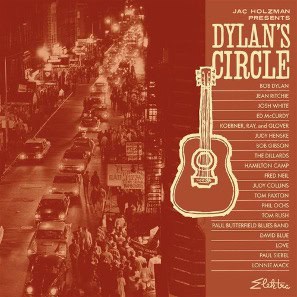
Curated by Jac Holzman and music historian Dr. Ted Olson to celebrate Elektra Records’ 75th anniversary, Dylan’s Circle showcases Bob Dylan alongside a variety of influential Elektra artists, including Fred Neil, Tom Paxton, and Judy Collins. This special collection honours the creativity, collaboration, and friendly rivalry that defined these artists, while paying tribute to the lively Greenwich Village music scene of the early 1960s, which had a transformative impact on modern American music and politics.
It fostered a close-knit community of singers, songwriters, poets, and activists who redefined folk music and sparked major social movements. Inspired by traditional American folk pioneers such as Woody Guthrie, Lead Belly, and Pete Seeger, this new generation of musicians brought youthful idealism and political urgency to these traditions.
Artists like Bob Dylan, Joan Baez, Phil Ochs, Dave Van Ronk, and Peter, Paul and Mary grew out of—or were deeply influenced by—this scene. For them, folk music was much more than entertainment: it became a tool for protest, unity, and social change. Through their songs, they voiced movements for civil rights, nuclear disarmament, workers’ rights, and opposition to the Vietnam War, leaving a lasting impact on both music and American history.
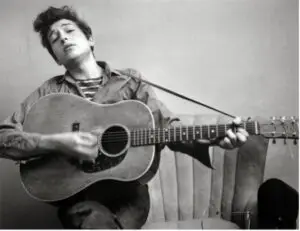
Elektra Records, later known as Elektra Entertainment, an American record label founded in 1950 by Jac Holzman and Paul Rickolt, played a significant role in shaping contemporary folk and rock music from the 1950s through the 1970s. This CD set captures much of the youthful idealism of early folk performers, spanning the years 1954 to 1971.
To an extent, it documents the music embodied in the 2024 movie A Complete Unknown, which focused on Dylan’s early years and his controversial appearance at the 1965 Newport Folk Festival. The album’s compilation (which commenced in 2017), however, predated the movie release; it serves to correct the film’s oversight of Elektra Records and Elektra artists as being essential to Dylan’s artistic development.
As Dr. Olson explains in the accompanying booklet, the collection celebrates a musical community united by mutual respect for the cultural roots of American music and a shared belief in music’s transformative power. Bob Dylan, he notes, “may be at the center of this album’s collaborative circle… but the catalyst for forming this circle was not Dylan — it was Jac Holzman.”
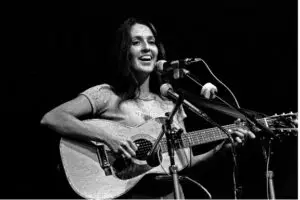
Highlights of this 20-track collection include Jean Ritchie’s Nottamun Town (whose melody may have influenced Dylan’s Masters of War), Fred Neil’s Bleecker and MacDougal, Paul Siebel’s Louise, and Judy Collins’s cover of Dylan’s Tomorrow Is a Long Time. The set also features notable performances from Dylan himself, including Maggie’s Farm and North Country Blues from the Newport Folk Festival.
Incidentally, Dylan’s Maggie’s Farm is a reinterpretation of the 1929 Johnson City Sessions recording of Down On Penny’s Farm by the Bentley Boys. Coincidentally, Dr. Olson co-curated a multi-CD set of the Johnson City Sessions for the German Bear Family label.
Additionally, Dylan’s Circle presents two impactful civil rights-era songs: Phil Ochs’s Here’s to the State of Mississippi and Tom Paxton’s Goodman, Schwerner and Chaney. The Dillards’ 1964 Walkin’ Down The Line, however, is a bluegrass adaptation of Dylan’s 1962 composition, and Lonnie Mack’s The Man In Me leans more toward Southern rock than Greenwich Village. The two Dylan tracks were included because they connect him to Elektra artists.
North Country Blues was performed by Dylan at a 1963 ballads workshop at Newport hosted by Jean Ritchie, while the 1965 “electric” performance of Maggie’s Farm at Newport featured Dylan with three members of the Elektra-affiliated Paul Butterfield Blues Band.
Dr. Olson’s detailed liner notes maintain his usual high standard and offer insightful commentary on the album’s music and the artists involved. The CD can be purchased online through sites like Amazon and at other retail stores. A double-long-play vinyl album is also available.
I highly recommend this set as a commemoration of the urban folk music of the 1960s.