Anna Valcour
I first heard “Black Lung” by Hazel Dickens in a graduate seminar taught by Dr. Taylor Ackley and was overwhelmed by her haunting, raw, lonesome sound – or as Hazel put it, “hard-core…it’s all feeling and emotion.” And she’s right. But then, I learned her story, and it gripped me even further. Following the death of her older brother, Thurman, she wrote “Black Lung” in 1969, “so that he would have some kind of a voice in this world.”
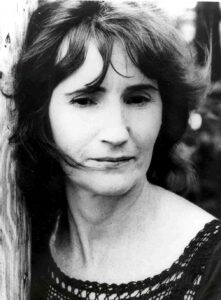
Growing up in a poor, working-class family from Mercer County, West Virginia, Hazel’s family (her brothers, brothers-in-law, and cousins) all worked in the mines. You see, West Virginia is a big producer of bituminous coal. Although Hazel was not a miner, she felt the struggles mining families endured and experienced the horrible treatment they received at the hands of the company bosses, gun thugs, medical doctors, insurance companies, and the US government.
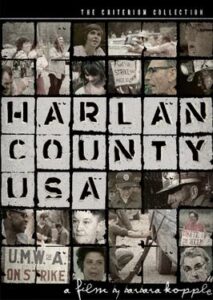
And if you’re ever near Matewan, WV – check out the West Virginia Mine Wars Museum. For a travel-free immersion, I fell in love with the heart wrenching documentary, Harlan County, USA, directed by Barbara Kopple in 1976 – it also features music by Hazel Dickens!

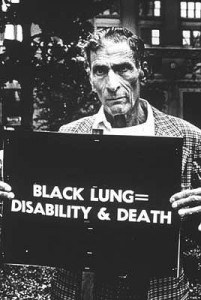
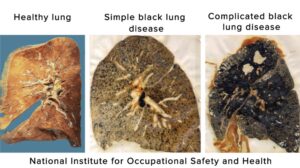
Black lung disease (or, coal miner’s pneumoconiosis) is an occupational lung disease. It’s from breathing in coal dust over an extended time. It scars the lung tissue, inflames the lungs, and makes it very difficult to breathe. However, the Center for Disease Control (CDC) states that “black lung disease is entirely preventable” with proper ventilation and precautions. Today, we’re actually seeing a resurgence of black lung disease. But if it’s preventable, why does it even exist?
Let’s take a brief trip through history. For a long time, mining companies and medical doctors (often paid for by the mining companies themselves) simply ignored miner’s respiratory distress. Instead, they labeled it as “miner’s asthma,” a benign, commonplace condition, and blamed the disease on the individual miners and their behaviors. In Life, Work, and Rebellion, David Corbin explains, “the coal operators fought [miners and the United Mine Workers of America] back, charging that the dust control standards were not necessary, too costly, and would force them to close mines.
They enlisted the support of county medical societies, which issued statements that claimed there was not enough medical evidence to support the miners’ claims. Dr. Charles Andrews, provost for health services at West Virginia University actually claimed that ‘smoking is the most important factor in the development of black lung.’
It wasn’t until 1969, that black lung was officially recognized as a disease with the passing of the Federal Coal Mine Health and Safety Act – the same year Hazel Dickens penned Black Lung. I also want to note that black lung is just one way in which poor, working-class people’s bodies are destroyed by manual labor and the willful dismissal of the cost and exploitation of human labor.
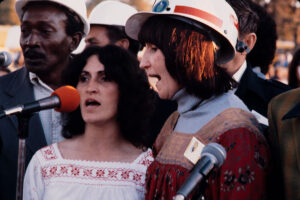
When we think of Appalachian coal mining songs, immediately Tennessee Ernie Ford’s Sixteen Tons, Merle Travis’s Dark as a Dungeon, Loretta Lynn’s Coal Miner’s Daughter, or more recently Tyler Childer’s Coal or Kathy Mattea’s album COAL, may pop into our heads. But there’s actually a rich history of women’s Appalachian folksongs too! In fact, Hazel Dickens joins a powerful list of women’s musical activism in Appalachian coal mining labor protests.
This tradition includes Aunt Molly Jackson, Sarah Ogan Gunning, Florence Reece, Della Mae Graham, Phyllis Boyens, Eleanor Kellogg, and so many more. Although not a songwriter, I would also be remiss if I didn’t include our beloved and fearless Mother Jones too.
You may have heard such impassioned pieces as Come All You Coal Miners (Sarah Ogan Gunning), Which Side Are You On? (Florence Reece), Dreadful Memories (Aunt Molly Jackson), or Dream of a Miner’s Child (Phyllis Boyens). Songs like these were often sung on the picket lines, in soup kitchens while caring for striking miners’ families, and at protest rallies and union meetings.
For example, one of the earliest performances Hazel Dickens gave of Black Lung was at the United Mine Workers meeting in Horse Creek, Kentucky to challenge the Social Security Administration as many miners were not receiving benefits and black lung victims were being systemically ignored.
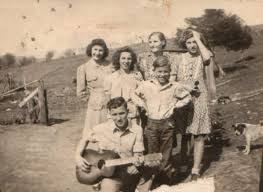
Black Lung was born from Hazel Dickens’s lived experienes and caring for her brother in the final three weeks of his life. She recalls,
he was born, lived, and died poor. He didn’t even have enough money to bury himself. His horrible death took a toll on me and affected the way I thought. My song…really came from the gut. I didn’t hold anything back. I didn’t fully realize until after I wrote it what I had. (Malone & Dickens, Working Girl Blues).
Now, let’s listen to Hazel Dickens’s chilling Black Lung. Listen to the rawness of her expression, the intimacy of her breathing, and the devastating depth in her words. The story opens by calling the mines a heartless lover – never even a friend – driving Thurman down a diseased path of no return. He speaks directly to black lung (Devil/Death) in the second and fifth verses.
In the third verse, we meet more killers: the boss man and the insurance companies. They ignore Thurman’s struggles that have left him in dire poverty, starving, alone, broken, and doomed to die. The cold, damp place where he’s spent his life digging, then becomes his grave. The final verse is forcefully poignant and filled with grieving anger at the injustices Thurman faced.
The hypocritical boss man offers insincere condolences – he’s rightly told to get lost. It’s already done. A good man is dead. But Hazel shows us it didn’t have to end like this. With a caring employer, protective measures against coal dust, proper ventilation, fair wages that don’t keep people in a state of perpetual poverty, and a healthcare system that prioritizes people over profit, Thurman’s life –and the lives of countless other miners – could have been spared. What’s missing here is compassion, humanity, and empathy. And it can change the world and save lives.
Now, let’s listen to Hazel’s breathing. Did you notice how often she breathes? The frequency of her breaths contrasts her other works, like Coal Tattoo and Pretty Bird, which feature longer, sustained vocal lines. For Black Lung, though, she often breathes in the middle of sentences. It may reflect her personal experiences – particularly, the memory of her brother’s declining ability to speak as his illness progressed.
Her breath patterns evoke the suffocating reality of black lung: the constant gasping, interrupted speech, and struggle to finish a sentence. One of the most powerful moments occurs in the final verse: “a good man’ is gone”. The breath she takes after “man” creates a charged silence—a sonic representation of loss and absence. This breath, or lack of voice, becomes the sound of death itself.
Black Lung” by Hazel Dickens
He’s had more hard luck than most men could stand.
The mines was his first love, but never his friend.
He’s lived a hard life, and hard he’ll die.
Black lung’s done got him. His time is nigh.
“Black lung, black lung, you’re just biding your time.
Soon all this suffering, I’ll leave behind.
But I can’t help but wonder what God had in mind
to send such a devil to claim this soul of mine.”
He went to the boss man, but he closed the door.
Well it seems you’re not wanted when you’re sick and you’re poor.
You’re not even covered in their medical plan,
and your life depends on the favors of man.
Down in the poorhouse on starvation’s plan,
where pride is a stranger and doomed is a man.
His soul full of coal dust ‘till his body’s decayed.
Everyone but black lung’s done turned him away.
“Black lung, black lung, your hand’s icy cold.
As you reach for my life, you torture my soul.
Cold as that waterhole down in the dark cave
where I spent my life’s blood, digging my grave.”
Down at the graveyard, the boss man came
with his little bunch of flowers. “Dear God! What a shame.”
Take back those flowers. Don’t sing no sad songs.
The die has been cast now. A good man is gone.
On a lighter note, this year also marks the hundredth anniversary of the Hazel Dickens. She was a staunch labor activist, pioneering bluegrass musician, feminist, compelling artist, and West Virginian daughter. Last month, the inaugural Fly Away Home Fest celebrating Hazel Dickens 100th Birthday featured artists Annie Neeley, Heather Hannah, Brittany McGuire, Sar Rudy, Makenna Hope, Emmy of the Mountains, and The Carpenter Ants. This month, the Grey Fox Bluegrass Festival will celebrate “Hazel at 100” on Thursday, July 17 with Della Mae and special guests Alice Gerrard and Laurie Lewis. Check it out if you can!