From Celina To Twang Town?
James E. Akenson
Tennessee Tech University (Retired)
Cookeville, Tennessee, U.S.A
Celina, Tennessee and Hibbing, Minnesota share something in common in my psyche. No, we won’t do a Hee Haw “Salute to Celina (Population 1,424) or Hibbing ( Population 15,940). But the link in my psyche is worth a different Hee Haw salute. Hibbing claims one Robert Zimmerman a.k.a. Bob Dylan) as native son. SAAAALUUUTE!! Celina claims Cherokee Hope as native daughter. SAAAALUUUTE!!
Both are small towns.
Both Bob Dylan and Cherokee Hope are interesting, worth recognizing, and have a connection to Country Music.
Both Cherokee Hope and Bob Dylan have a connection to each other.
Let’s check on the connections. Most important, though, let’s explore Cherokee Hope as a Country Music artist. Folks need to know more about Cherokee Hope.
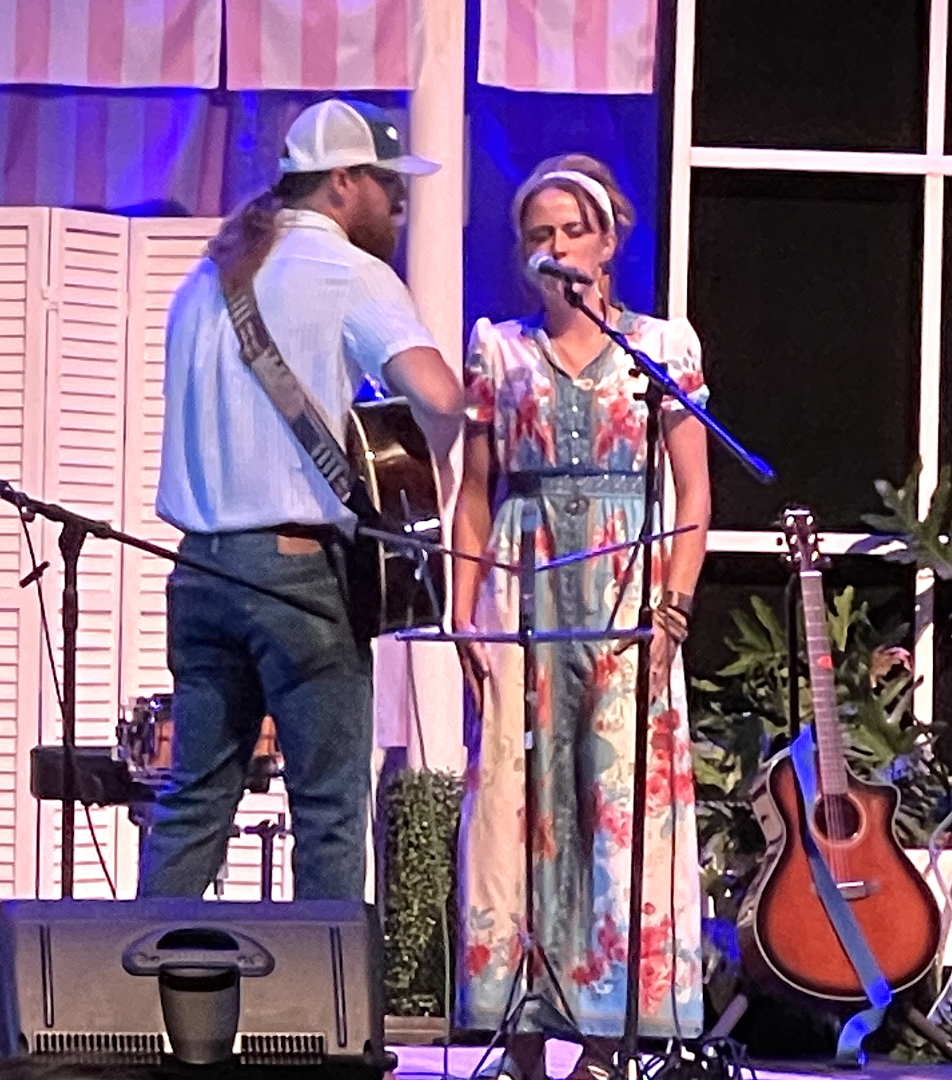
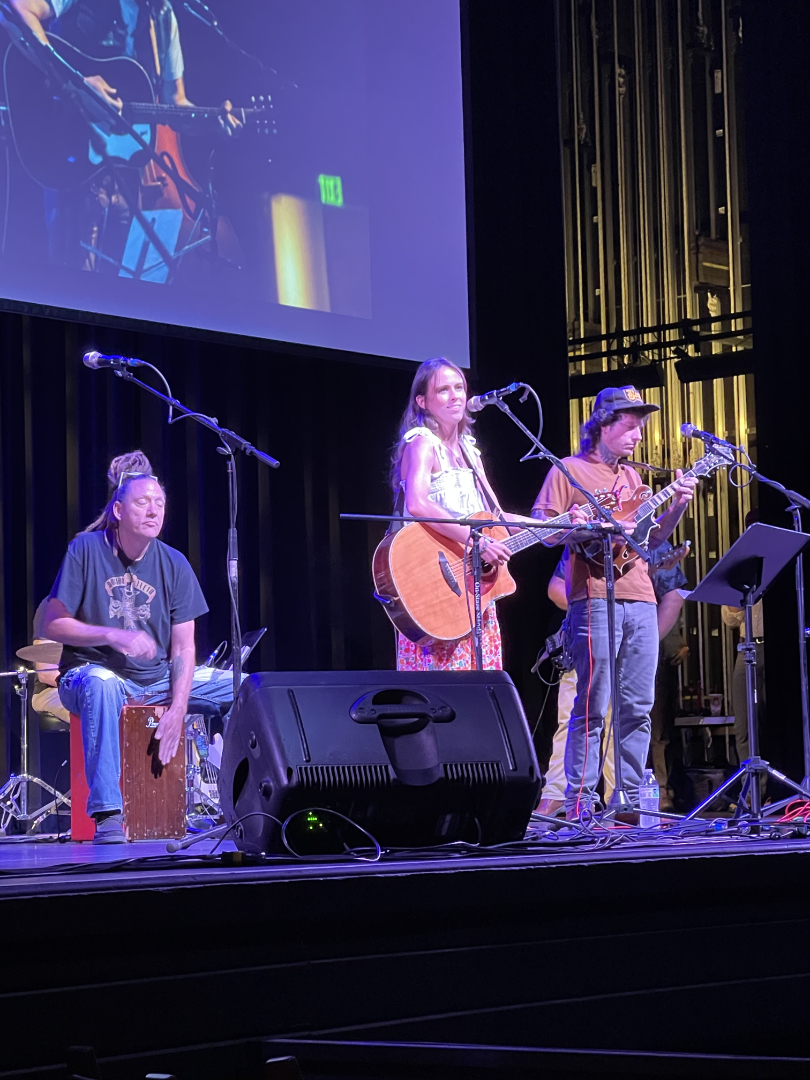
Community Sings Bob Dylan 1 and Community Sings Bob Dylan 2 makes for a significant link. Cherokee Hope performed in both Community Sings Bob Dylan performances at the Cookeville Performing Arts Center (CPAC) in 2025 and 2026. I had never heard of Cherokee Hope before Dylan 1 and I found her intriguing. At Dylan 2, I managed to give her my old Tennessee Tech University business card. I told her I knew her fellow artist Andrew Buckner…a former student at Tennessee Tech… in her The Foxfire Band and would like to interview her sometime.
Why did I find Cherokee Hope interesting? Well, since you ask. She seems to be in her early 20s. She’s from Celina in the rural Upper Cumberland Region of Tennessee and Kentucky. Her name Cherokee Hope isn’t quite typical.
Going out on a limb, I’m thinking that at least one of her parents may be somewhat like Flower Children who settled in Tennessee during the Counter Culture of the 1960s and 70s. Maybe her parents were the offspring of Flower Children and she is the granddaughter. Am I on target? Beats me. I have yet to interview her. That’s for another Cherokee Hope artivcle
Cherokee Hope’s Facebook page describes her as an Independent country singer songwriter from middle TN. “I like to be in the woods.” She sings solo but is part of Cherokee Hope & the Tribal Elders.
She’s half of The Foxfire Band with my former student Andrew Buckner. Both band names suggest to me that Cherokee Hope has connections that transcend typical roots.
Her Facebook page doesn’t say that she grew up singing gospel songs in her hometown Baptist church and her parents or grandparents played Merle Haggard, Garth Brooks, or even Trisha Yearwood on their record player, cassette, CD, or even…dare I suggest…streaming.
But…a local newspaper article does say she first sang “The Old Rugged Cross in Church” and credits “her mom introduced her to Old Country and Bluegrass music.” Her father introduced her to Rock and Woodstock era music.” I’m still thinking that Cherokee Hope benefitted from a traditional yet funky upbringing.
Since I haven’t interviewed Cherokee Hope let me venture further afield and offer some further analysis that might be on…or off…target. Her earliest performances I could find were staged as authentically rural. The Rodburn Hollow Sessions sounds rural and Appalachian. Remember Loretta talking about the hollers?
In the videos, the hollow…or holler…is real, steep, and awaiting spring to arrive. She wears long straight hair, no makeup, a fringed buckskin jacket, a long brownish-orange floral gingham dress, brown boots and plays her guitar. That’s straightforward, unvarnished “Country.’
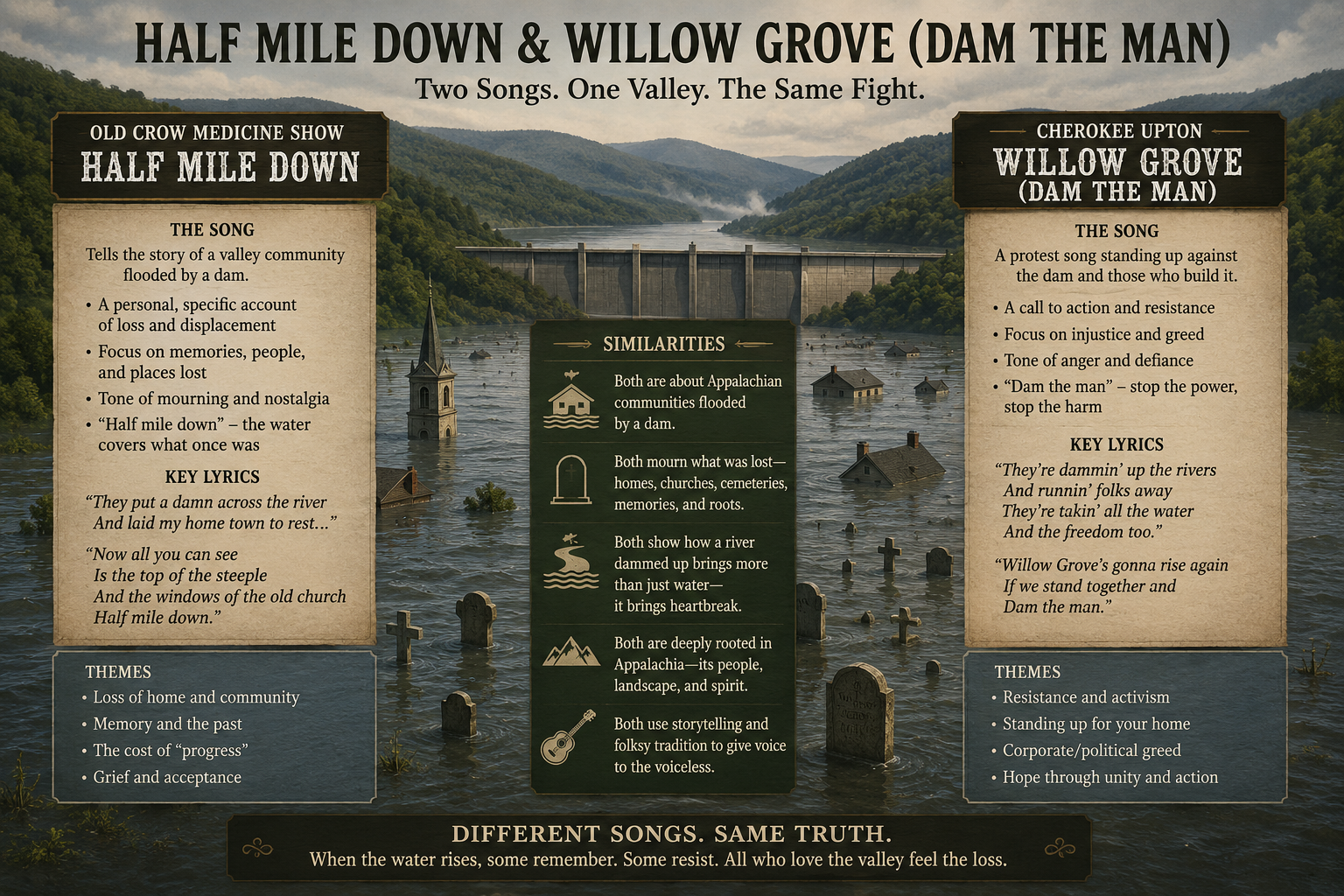 Another song from The Rodburn Hollow Sessions connects Cherokee Hope to very hip groups such as Old Crow Medicine Show and sentiments doubting the benefits of the Tennessee Valley Authority (TVA).
The Great Depression of the 1930s brought power to the Tennessee Valley, but required some families to leave their homes as dams raised the water level. Pete Seeger saw TVA as a great benefit, but naysayers do have their day.
Old Crow Medicine Show’s Half Mile Down deals with the TVA dam that created Lake Watauga in East Tennessee. The town of Butler now sits at the bottom of lake Watauga. Half Mile Down laments that “…my home town is a half mile down…” as a result of the men from “Washington City” coming to the idyllic countryside. The maximum depth of Wautauga Lake is 256 feet. Not quite a half mile which is 2,640 feet. Artistic license does make the story better.
Cherokee Hope’s Willow Grove (Dam the Man) takes a similar view of TVA’s efforts to modernize the Tennessee Valley. Lyrics don’t focus on lighting rural homes or bringing running water into homes. Some women wept the first time they turn on running water.
Hauling water into the house offered relentless exhausting labor. Lyrics mention moving Daddy’s grave. Like John Prine, Cherokee Hope references damming the river as ‘the progress of man” while it “drowned the life I’ve known.”
Cherokee Hope clearly establishers herself visually and musically in the company of Country Music’s folk oriented sector. She comes across as an authentic artist drawn from the Tennessee and Appalachian culture.
Artificial intelligence (Ai) may be the last thing appealing to artists steeped in the authenticity of the Tennessee hills. Take a look at, though, what Ai created to a prompt to compare Old Crow Medicine Show and Cherokee Hope.
Cherokee Hope struck me at the first Community Sings Bob Dylan presented in June 2025 at the Cookeville Performing Arts Center (CPAC). It was an assemblage of artists and the faithful honoring Dylan. She sang It Takes a Lot to Laugh, It Takes a Train to Cry and You Ain’t Going Nowhere. Yes.
Bob Dylan grew up listening to Hank Williams and has had an impact on Country Music. Dylan has recorded in Nashville. Cherokee Hope also participated in Community Sings Dylan 2 in June 2026. Again, she sang It Takes a Lot to Laugh. It Takes a Train to Cry.
Cherokee Hope recently opened for a Dolly Parton tribute show at CPAC. I thought that as the opening act Cherokee Hope would sing her original songs or cover some classic songs by women other than Dolly. Maybe something by Kitty Wells, Tammy Wynette, or Loretta Lynn.
Dolly songs might take away from Natasha Neely’s headline Dolly tribute. Cherokee Hope ‘Done Good as they say in the English Department.’ How about opening the evening with Hank Williams? I’m So Lonesome I Could Cry touched me. That sealed the deal for me.
Cherokee Hope sang John Wilkes Booth which isn’t your typical Country Music fare although The Civil War has a long presence in Country Music. She covered the Judds Had a Dream (For The Heart) and did a fine job on Loretta’s You Ain’t Woman Enough to Take My Man. I’m pleased she did Willow Grove (Dam the Man).
She concluded her set with an original song about Home. Cherokee Hope wore her blue summer gingham dress and played guitar. She came across again across as a traditional, authentic artist. All in all, a fine opening act!
Although I thought I have a handle on my analysis of Cherokee Hope…maybe I don’t. I decide to ask a far more accurate, omniscient source. Artificial intelligence (Ai) about Cherokee Hope. I asked Ai in terms of Cherokee Hope’s Country Music identity and the possibility of a Counter Culture connection.
Let’s see some things that Ai says about Cherokee Hope. Note that Ai likes to make things personal. You get attached to Ai if you’re not careful. Ai really ain’t a person!
I would place Cherokee Hope in a category that might be called”Neo-Appalachian Heritage Revival” rather than “Direct Counterculture Descendant.”
..there is no evidence that she is the child or grandchild of flower children, hippies, or back-to-the-land settlers. However, her music appears to draw from the same ingredients that often attracted those migrants:
-
- attachment to place,
- rural memory,
- local history,
- folk storytelling,
- and resistance to cultural homogenization.
Ai didn’t mention anything about religion. Singing The Old Rugged Cross in a Baptist church for your first performance is a signifier for sure. That means Ai doesn’t subscribe to the Jackson County Herald.
Ai didn’t mention the role of the mother as inducting her into Old Time, Bluegrass, and Country Music. Nor did Ai mention that her father introduced her to Woodstock and rock music.
Now that dichotomy still holds the possibility of some family history with at least flirting with the Counter Culture movement. It also fits with the Sacred and Profane…saved and lost, heaven and hell, purity and lust, Saturday sinner and Sunday saint…. dichotomy that Randy Williams and I research about Country Music. Woodstock 1969 and the Baptist Church fit the Sacred and Profane dichotomy.
I’ll be interested to see if Cherokee Hope changes her vibe a bit to become more Nashville mainstream Country Music focused. After all, you have to make a living in this world. Becoming more mainstream and commercial isn’t a sin.
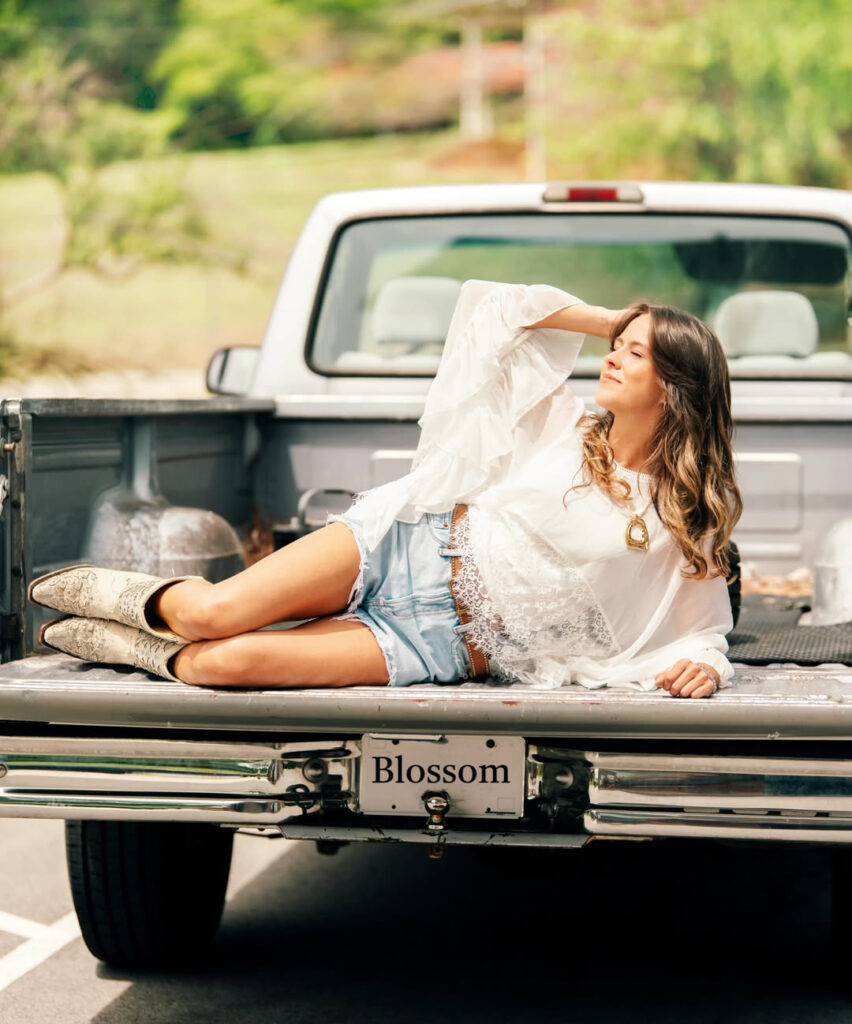
Tweaking your style to generate income and savings for the future is reasonable. I’m thinking a slight shift to the commercial center could happen. Take a look at the recent pic in the back of a pick-up truck.
Now that’s a Country Music signifier. It doesn’t take a Bob Mackie to sense that the boots, hair, shorts, and top seem to be more contemporary country. It’s not Ashley Cooke, but it’s veering that direction.
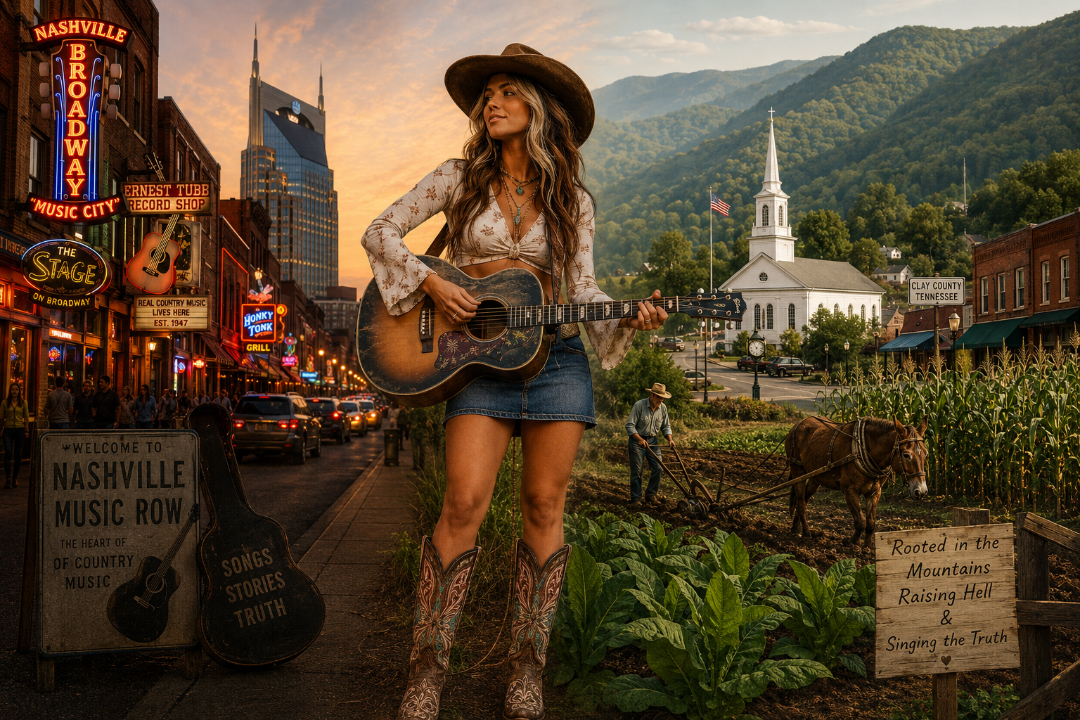
Her Ai generated performance for The Italian Bistro in Burkesville, Kentucky certainly has a more contemporary denim, sleeked back ponytail, hint of bare midriff, and a bit of a neckline. Note Ai responded to directions to have an Appalachian style ridge and valley country background.
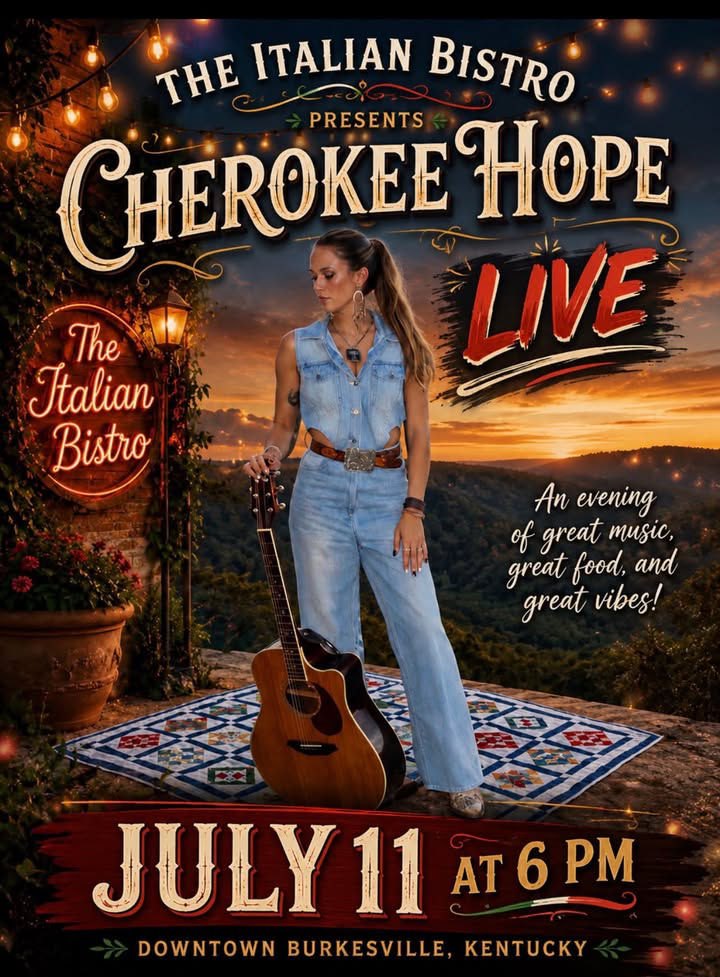
Ai admitted it’s not “possible to predict with confidence whether Cherokee Hope Upton will become a mainstream country music superstar.” Ai listed a variety of variables such as “quality and consistency of songwriting and recordings” as well as management, radio airplay, growth of fan base, trends, and even luck.
Hard work alone though isn’t a guarantee. Ai said superstar status is rare. And, “highly talented artists often have rewarding careers without reaching the level of artists like Dolly Parton, Lainey Wilson, or Chris Stapleton.”
If Cherokee Hope wants mainstream Nashville…Twang Town…commercial success I have a conceptual thought. Cherokee Hope could balance her strong rural Tennessee roots and blends them with common Country Music themes and imagery.
She can be authentic, true to herself, and yet commercial. I asked Ai to blend these items an create an image that shows Cherokee Hope creating a balance. Take a look. I think it makes sense. No telling if she will pursue this route. It’s her life.
In any event, I think Cherokee Hope can remain authentically herself. As she journeys through life I believe she will create and perform original and classic Country Music. Cherokee Hope will make our lives richer as she labors in the Country Music vineyard.
Cherokee Hope…a vintage with depth and richness that ages well, providing a complex finish, showing the ‘terroir’, the characteristics of the Upper Cumberland and Southern soil clearly lingering in every note. Now that’s Country!