Dave Sichak
Initiator of hillbilly-music.com
Modesto, California
2026
Hillbilly-Music Dot Com has been a labor of love. Love of Country Music . I have learned from developing Hilly Billy Music Dot Com and have provided a research tool for the Country Music community. The site has grown and evolved, but the overall design and concept has remained the same. I’m going to share the technology changes – and I will try to keep from diving into geek speak. I will talk about the site hosting, the site database and the site scripting language. It changed and in some cases, the change was forced due to … technology.
The Site and the Theory of Evolution
The site started on a simple ISP site I found. I opted to use MS SQL as the backend database and since I was familiar with ColdFusion from my daytime job, implemented that to develop the structure as well as drive the display of pages.
The database has a few dozen tables. I’ve added only a few since I started in 2000. The fields are much the same, though the main table for artist information has changed somewhat that also caused adding some new smaller tables.
The use of ColdFusion allowed me to design the pages using templates so I could reuse code without having to copy the same stuff over and over. This would prove to be handy later on.
Another ISP found my site. Like the classic movie, they made me an offer I could not refuse. Offered to host my site for free. The only thing I had to do was migrate to a MySQL database and change the scripting language from ColdFusion to PHP.
I may have been unknowingly smart in that initial design. The templates were easy to migrate – the only thing that changed was the display output code and the query code. But the templates could stay in place. It was relatively quick – I did all of the recoding in one weekend. That aspect has been relatively unchanged.
I avoided using Content Management Systems such as Word Press or Elementor and their numerous plug-ins. I used that on another site I manage for a non-profit. I just did not see how that worked with a data driven site. We will come back to this later.
Technology Revolution and Falling Prices
There are several pieces to this that were key to growing the site. First – the ability to scan documents such as magazine pages, radio station booklets, scrapbooks, newsletters, and of course, photos.
Initially it was a slow and labor intensive process. How many of you remember using a SCSI adapter to drive your scanner that was sloooooow? Then I found one that was discarded at work – it had a document feeder! The evolution revolution was underway.
One Christmas break at work – we had the ten days off – and the wife was on a trip. So, I did what any geek would do – I moved three scanners I had into the living room and started scanning in bulk, both single pages and via the document feeder.
By then I had developed a numbering and identification scheme. Each ‘source’ had a unique code and had page numbers associated with each scanned page. But the prices of technology were dropping. We had an electronics chain out west called “Fry’s Electronics.” When I lived in San Jose, we would wait for the Friday paper to see the advertising insert from the store to see what was on sale.
Scanner prices began to fall. I was able to ditch the SCSI adapter and also upgrade the computer to a faster speed and more RAM.
The next issue was hard drive space. Oh, I had lived through the 5.25” and 3.5” floppy era. The CD ROM era of storage. Then hard drives were going from MB (megabytes) in size to TB (terabytes) in size.
As fast as I scanned material, my need for hard drive space increased as well.
I’ve gone through about 3 or 4 computer upgrades since 2000. Each time, more RAM, more HD space. Today, a terabyte hard drive hardly seems enough. But I also have external drives – powered or connected by USB cables.
Now? Well, the computer has a TB hard drive. But there are two external drives attached. One is used by the backup software. Yes, in this day and age, you have to backup key files and folders. I learned that as an IT professional.
The last scanner I added was a large format scanner / printer. Mainly used to scan newspaper size documents such as the old Music City News magazines.
Asleep At the Library Microfilm Reader – No Mo’
When the site was started, research went beyond the collection of material I had. I could not limit myself to just what I had. That meant getting to know the various libraries I could visit. The libraries I have visited and used go beyond the boundaries of where I live. This list will give you an idea:
- Stanislaus County Library
- Sacramento Public Library
- San Francisco Public Library
- UC Berkeley Library
- Stockton Public Library
- Los Angeles County Public Library
- San Jose Public Library
- Mountain View CA Public Library
Sure, I visited most of these early on and yes, had to take breaks as looking at microfilm reels is akin to falling asleep in the chair.
But technology evolved. Now newspaper archives are online and you can search without falling asleep. But there is a caveat. All searches are not equal and well, the OCR (Optical Character Recognition) capabilities are not 100% accurate.
The Dark Side of the Universe Attacks Hillbilly Music
I have to think my career path had its own purpose and would become useful. I came from a DOT com web application security company – in fact, we created that niche space. I got to use some nifty tools we developed that allowed me to carry some knowledge forward in my efforts.
A couple years ago the Darth Vader crowd across the ocean though they would mess with me and send their BOT army against my site. I won’t go into the dirty details, but when your site is getting 2,000 hits a minute, it is something that keeps you awake. The ISP shut down the site for a couple days to stop the attack. Then I found a solution on the web and get this, free. It allowed me to setup a firewall on the site (ah, my career came in handy). I could setup rules. But many of you have seen that little image crop up that asks you to acknowledge you are a human. Implementing that – the BOT army went away.
I put that knowledge to good use again. Another site I manage for a non-profit – well, they underwent a BOT attack. Luckily, there was a WordPress plug-in to implement this firewall and that stopped the BOTS.
The Numbers Side of the Universe
Let’s run some numbers up the flag pole in our discussion.
Page Views. That is, how many pages have site visitors looked at. I’m not done getting my statistics up to date, but as of this writing, over 44,700,000 pages have been viewed on the site by over 7,100,000 visitors.
In 2010 I had 27,000 pages scanned/digitized. By September 2026 – I had over 109,200 pages digitized. I use that to create my own searchable custom google.
I have a statistics query that I can run on my site. Very simple.
In 2010, I had over 3,500 ‘sources’ in my collection. Today, the collection has over 6,700 sources.
Part of the effort is documenting dates of birth/death. In 2010, over 1,800 dates of birth; just over 1,000 dates of death. Today, the data shows over 4,350 dates of birth and 3,900 dates of death.
Back in 2010, there were over 6,500 artists, groups and disc jockeys in the database. In 2026, it is over 8,200.
In 2010, I had over 44,000 ‘recordings’ in the database – that is I had listed only the 45rpm’s and 78rpm’s in the database. Albums – I left that for others as that could get messy. Dates of recordings or places? I left that for others. Today, there are over 53,000 recording titles in the database.
To maybe provide an example of how ongoing research impacts things – in 2010 there were 135 “programs” – e.g., Grand Ole Opry, Hoosier Hop, Town Hall Party, etc. In 2026, 201 programs have been discovered and documented in some way. The deep dives into those programs often result in interesting results.
Wayne Daniel posed an interesting thought in a 2007 email. He was suggesting that a definition of those programs was maybe needed to help define what gets included on the site. He wrote me:
“What I would really like to know is which of these were weekly, presumably Saturday night, stage/broadcast shows. I’m dreaming now, because I know the difficulty of determining the true nature of a show from its title. My research focus is on the barn dance type combination stage and radio shows. Shows like the GOO. Many of those were short lived. So a definition is in order. How many consecutive presentations would be needed for a show to qualify? One? Maybe? Two? Minimum? I’m thinking out loud.”
He also thought an idea I had to include a map of some sort to show where these shows were originating from. But the “fun” part of that might be – how would it work if the time periods were all different? Maybe show where the programs were by decade, regardless of length on air? You see how ideas get born and like a bowl of soup on the stove, bubble away as the ideas / flavors cook.
Then I got curious. I asked google how many “words” are on my web site. Some site told me I had over one million unique words (the free version would only count up to a million). It also told me that at the time (August 2026) there were 5,784,432 words on the site. That is a lot of keyboard pounding!
Databases Can Be Used In More Than One Way
The site you see is from the database using the queries set up for the various templates in use. But that also means the data can get used in different ways.
One example is what I ended up doing after I downloaded all of the weekly radio logs for Nashville radio from the start of the Opry’s history to about 1959 when the Nashville newspapers no longer listed them. That information became a subset of the site’s data.
First, on the Opry program page, I have listed the various artists that were listed to appear on a given Saturday night. It is not an entirely random display. It is based on week number that can be used in PHP scripting language. I made a choice that depending on the week of the year, then only that week number’s information would be displayed on that page. Thus, for example, October 14, 2026 falls in week 42 according to ISO standards and US calendar conventions. That means if you visit the Opry page during that week, you will see all the artists who appeared in week 42 of a given year. The database table was based on the weekly listings which are hard coded and because the HTML / PHP code is the same for each week, I could simply copy and paste the data output into a large Excel file where I could strip out the unnecessary text. Then used to create the table needed.
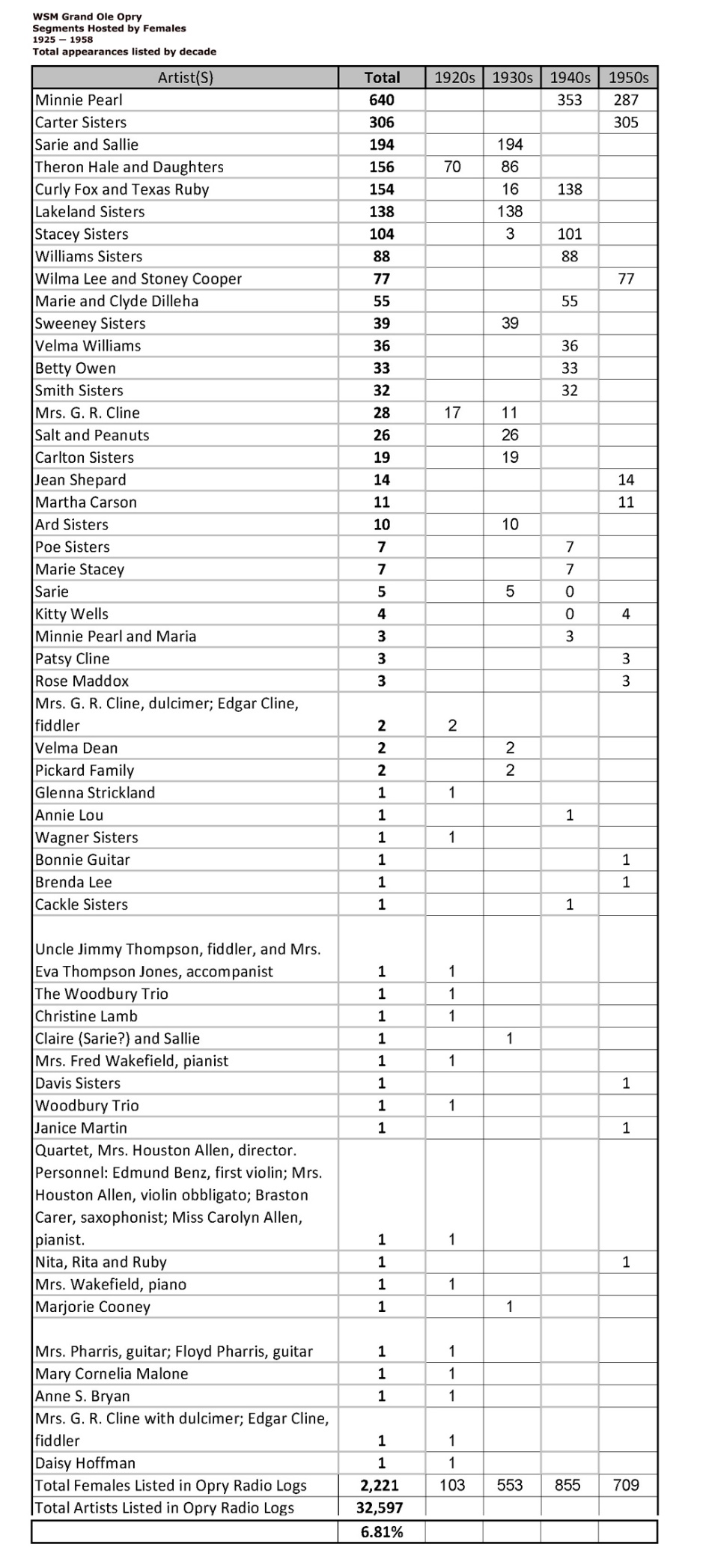
Let us take this a step further. One of the fields I added to the main table for artists was a gender code – M or F. I could take that data and put it in an access database where I was able to create simple pivot table views. One was a simple pivot that shows only those who were marked as “f” or female. I did this partly to help another researcher for his book efforts. But it also ended up showing how little females were listed as hosts of an Opry segment. It also showed that Cousin Minnie Pearl became a stalwart female blazing a trail that no other female act had done prior to 1960. See the following table.
One can see that the Opry up until 1958 at least, was male dominated. Female acts did not last for lengthy years. Female acts did not usually appear in more than two decades. The other notable factor was that females were only listed as a ‘host’ of a segment 6.81% of the time from the Opry’s start in 1925 through 1958. But it may have been less than that as I also included ‘groups’ that had known females listed as part of the act. For example, Theron Hale and Daughters. The females shared the ‘billing’ so to speak. Or the husband-wife duos. For example, Marie and Clyde Dilleha or Wilma Lee and Stoney Cooper. You can see defining aspects of the data can cause one to pause and think.
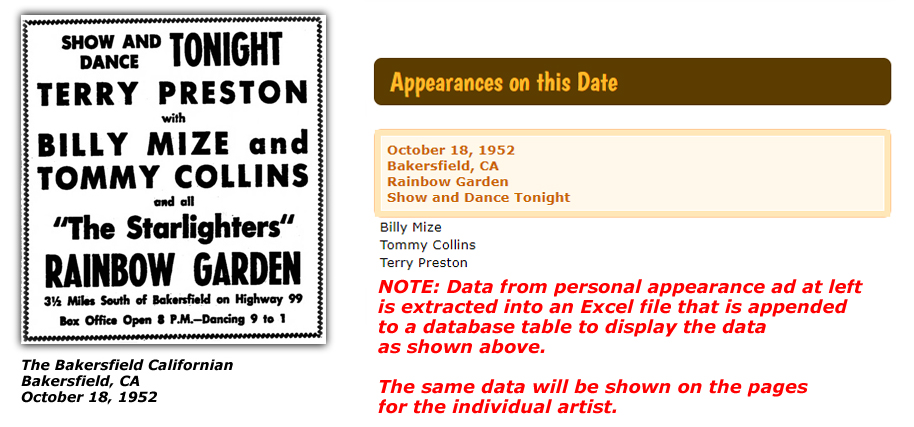
Another data driven secondary use on the site is the “appearances” that show up on artist and groups pages. While I started doing that, it required building a new database table for it with just a few fields to help use it in queries. But where does that data come from? It is from all of the promotional ads you see scattered throughout the site. I learned to start naming those ads a certain way that would enable me to sort or identify ads of a given year and month. The year can be irrelevant – it’s the month that helps pick out the data. So, about once or twice a year I sit down and pick a time frame and just manually create the excel file that will be imported into the database. That is what you see on the main artists page under “Appearances on this Date” heading next to the list of dates of birth and death for the given day one visits the page.
The first idea of incorporating personal appearance data was from a browsing the old WLS Standby magazines from the 1930’s. I mentioned what I was going to do to Wayne Daniel who was a sounding board for things and gave me insights into various topics. He wrote me in September 2011:
Dave,
That is awesome information. It adds a dimension that seems to bring the artist alive.
Thanks for letting me know.
I hope you enjoy the CD.
Have a Happy Labor Day Weekend.
Wayne
I noticed as I wrote this no appearances from October were showing up. I went to the command prompt in Windows (yes, there is still a use for that old DOS window) and searched for any promotional ads that had the month of October in its naming convention. That command was “dir ?????_ad??10*.jpg /s” and that showed me over 190 ads I could pull data from. By the time I submit this I should have that process done and in the database.
So you can see how the database is used to drive what is displayed to the user at various pages on the site. Thus, pages can continue to grow as data is added.
Round-up Around the Camp Fire
As we sit around the campfire enjoying our drinks before heading off into the sunset, let’s lasso up some thoughts from this essay.
This was mostly about the technical aspects. I hope it might help someone who might be going down the road of doing a web site that doesn’t quite fit the cookie cutter programs.
What I did not delve into was the people I encountered doing this site. Early on, I got an email from a 90 year old artist who worked with Vernon Dalhart! Then there was getting used to ‘death’ – getting emails from a relative of someone thanking me for listing them on the site as that person had just passed away that day. I have corresponded with many artists over the years. It is notable that some of them in their elder years seem to adapt to email and can use it. There were many a story I was told. I have kept all the emails – over 25 years’ worth. I do search them now and again and am surprised at the ones I overlooked or forgot to follow up on.
I hope I’ve given you a geek’s eye view from the keyboard how the website is constructed and managed. Now, back to my to do list, which is secondary at home to the “honey do” list, know what I mean?
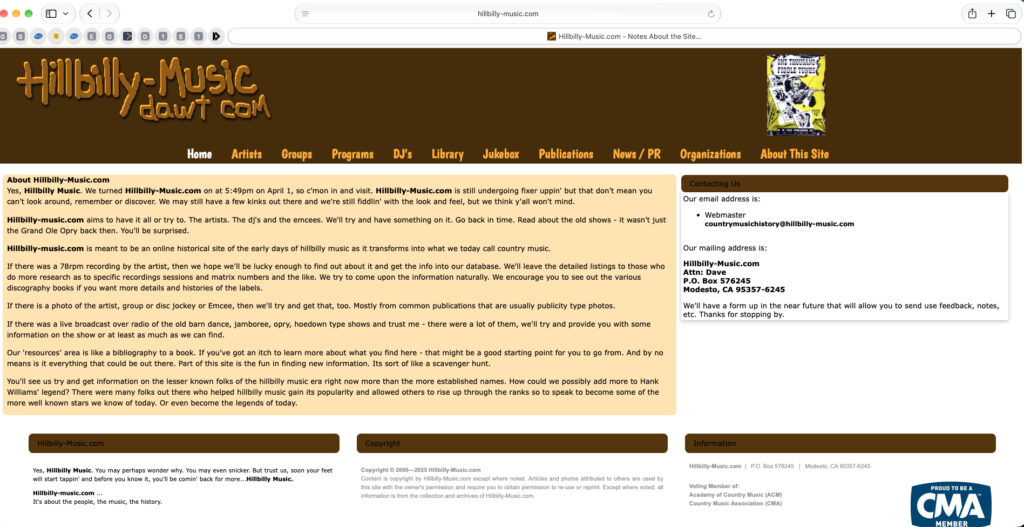
Appendix – Site Evolution in Design via Screenshots
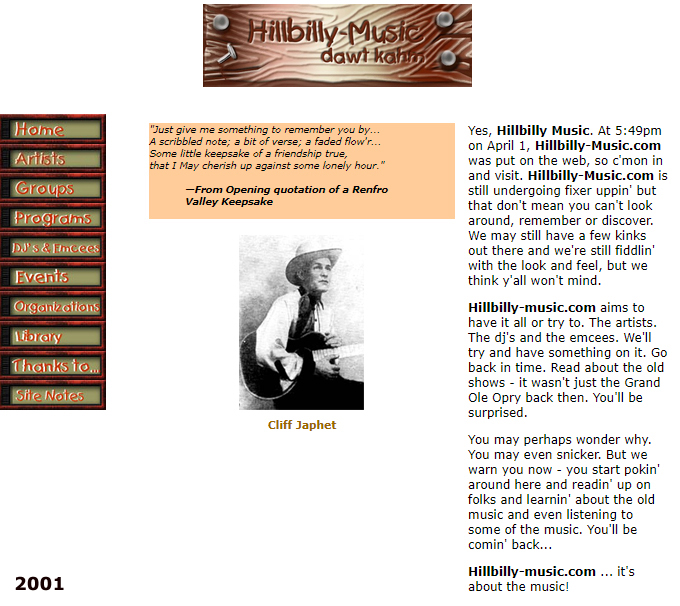
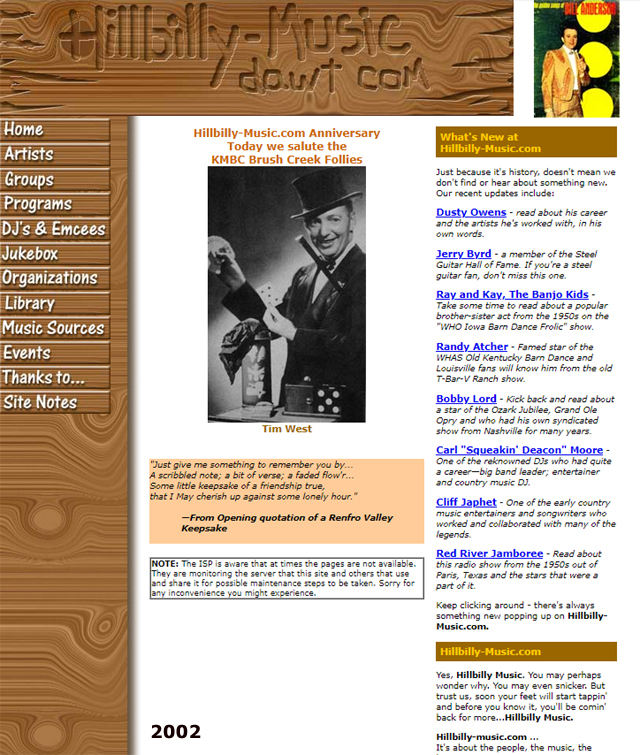
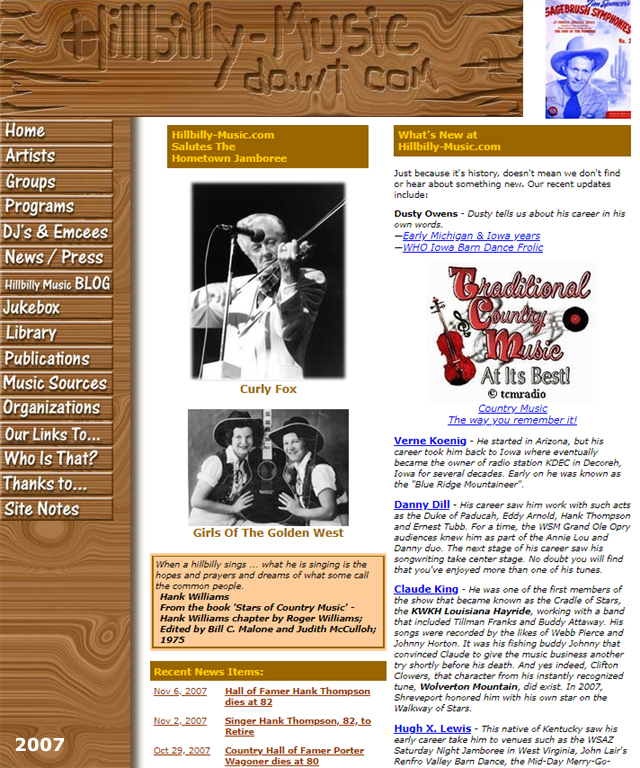
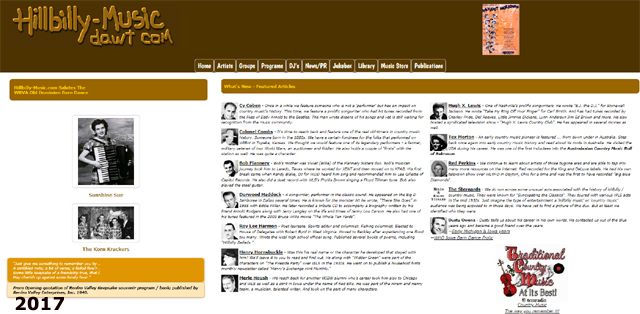
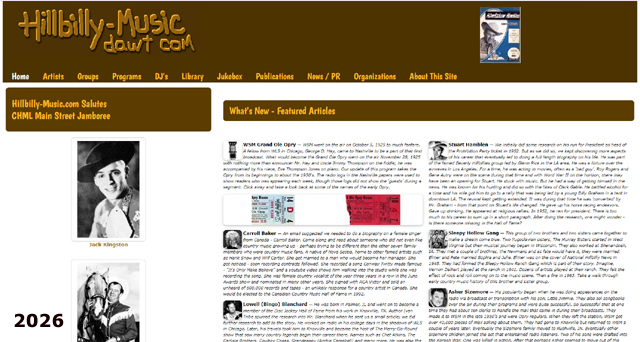
Below are some screenshots taken of the site over time from archive.org which has proved to be a good resource in many ways beyond website history.