Jordi Guasch
Barcelona, Spain
18th October, 2026
Editor’s Introduction – James Akenson
Jordi Guasch of Barcelona Spain continues to bring his unique perspective to dealing with varied forms of Country Music. Guasch finds relationships and analogies between Country Music and other forms of musical traditions. His travels to the “Roof of the World,” Pacific Islands and the United States provide Guasch with the raw material, the substance, with which to develop his unique insights.
I was surprised that Jordi Guasch could find a connection between Gregorian chant rooted in the Catholic traditions and Bluegrass. Bill Monroe would be impressed.
I couldn’t resist going to our Ai friend and asking if there were a relationship between Gregorian chant and Bluegrass. Ai responded.
At first glance, Gregorian chant and Bluegrass music seem to occupy two very different musical worlds. Gregorian chant evokes medieval monasteries, Roman Catholic liturgy and the contemplative atmosphere of sacred worship. Bluegrass evokes the Appalachian South, rapid fire banjo rolls, virtuoso flat picking, close harmonies and the lively interplay of acoustic instruments.
Yet there are some fascinating connections between them. Both traditions raise questions about community, musical transmission, vocal expression, spirituality, improvisation and authenticity. There is no well established historical evidence that Gregorian chant directly caused, or was a significant direct influence on the development of Bluegrass music.
Guasch, though offers evidence that suggests a casual link. He sites Ms. Jean Thomas in Ballad Making in the Mountains of Kentucky states that Bluegrass and Gregorian chant have a direct link. Guasch suggests that musicologists often compare lining out of hymns directly to Gregorian chant. Jordi Guasch provides an intriguing analogy comparing the two forms. He even includes a hypothetical reference “time machine”….thank you Mr Peabody and Sherman….travel to connect the two forms.
Enjoy a different perspective that you may not have considered in your past Bluegrass life.
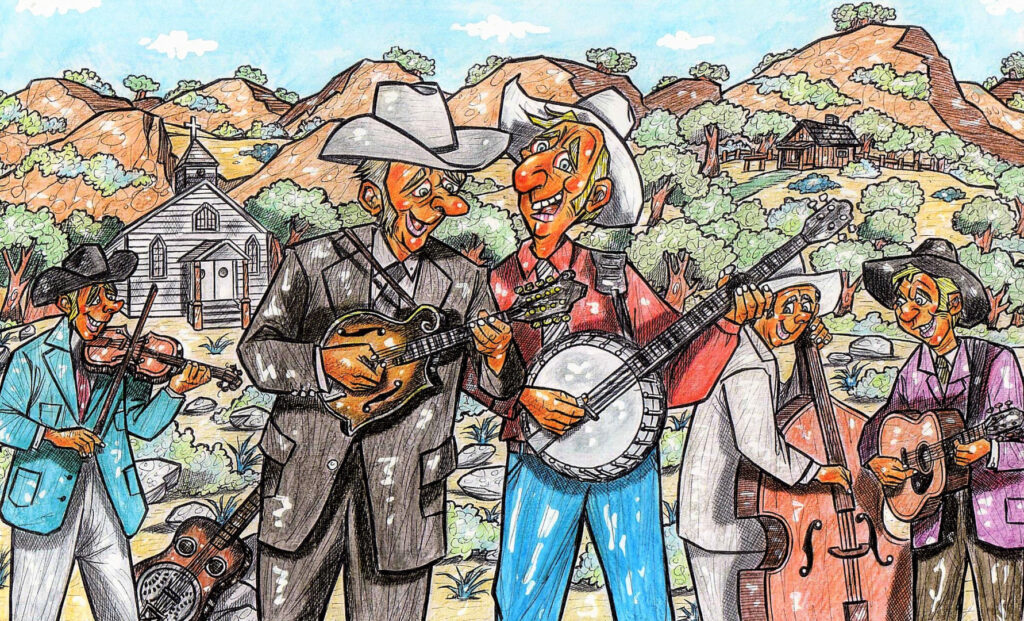
Bluegrass is a country music style created by Kentuckian Bill Monroe. Bluegrass is the string band genre of Appalachian old-time music and is influenced by jazz, ragtime, blues and gospel. Bluegrass acquired its definitive classic outline during the 1945-48 period with the incorporation of Lester Flatt and Earl Scruggs into its band.
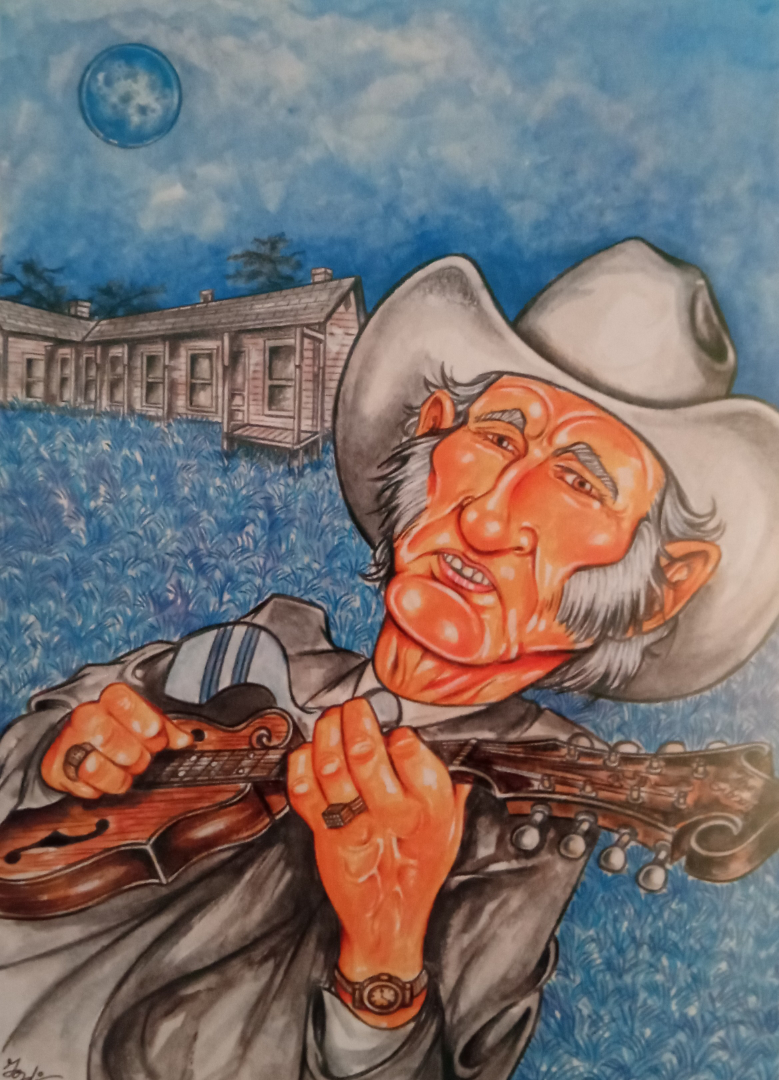
According to Robert Cantwell’s Bluegrass Breakdown, Bluegrass is simply an up-to-date and refined form of the old mountain dance band, particularly those North Carolina bands such as Al Hopkins´Buckle Busters or Mainer´s Mountaineers, who made much of their instruments and of the traditional instrumental breakdowns.
In this discussion, I’m going to expand the Bluegrass pallate to include Gregorian Chant that stems from Catholic tradition.
Bluegrass music, Cantwell asserted , echoes blues and ragtime, jazz and swing, and of course old-time country music from Appalachia. Alan Lomax observed that Bluegrass began in 1945, when Bill Monroe recruited a “brilliantly orchestrated” hillbilly quintet which contrasted sharply with the “originally crude” hillbilly orchestras that developed, Lomax suggests, in response to the presence of radio microphones.
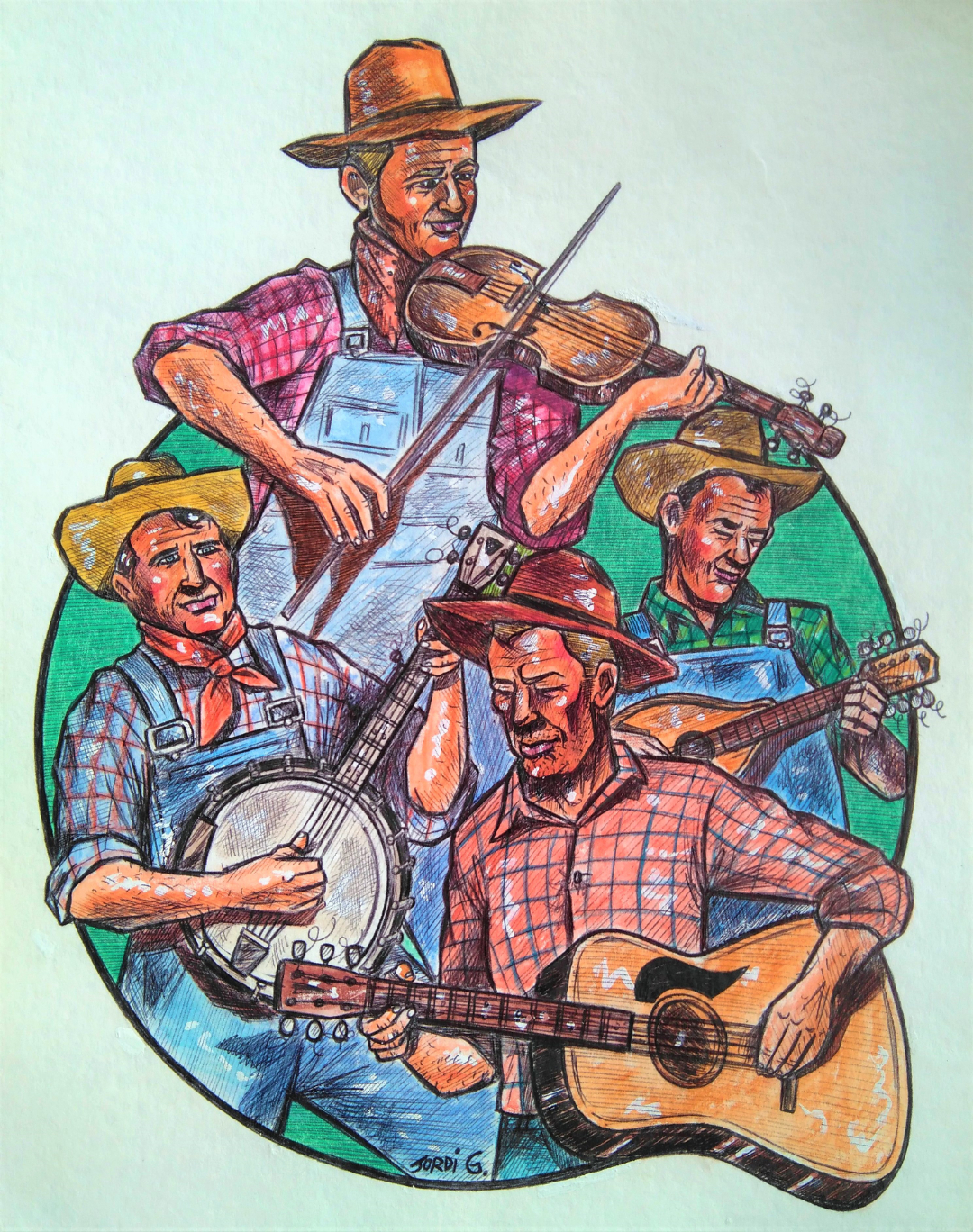 Lomax also said that a Bluegrass band was a sort of mountain Dixieland combo in which the five-string banjo, America´s only indigenous folk instrument, carries the lead like a hot clarinet. Taking up the jazz analogy the mandolin played bursts are reminiscent of jazz trumpet choruses. A heavily bowed fiddle supplies trombone-like hoedown solos.
A framed guitar and slapped bass made up the rhythm section. Everything goes at top volume, with harmonized choruses behind a lead singer who hollers in the high, lonesome style beloved in the American backwoods.
Cantwell mentioned important aspects within American traditional religious music such as psalmody. In the Catholic church, psalmody evolved into a rich and elaborate cultivated tradition we know as Gregorian chant. The final a in the word “Allelulia” traditionally receives a long drawn out vocalization known as the jubilus.
The jubilus had two forms, then-on outcry or call, and a chant or surge-and it was traditionally linked to psalmody. There is ample precedent in liturgical song, then, for the American “vocal peculiarity”, the “long drawn out notes on the vowel sounds”. Yet how did this medieval and Catholic tradition emigrate to Protestant America?
In 1939, the year Bill Monroe and the Blue Grass Boys debuted on the Grand Ole Opry, Monroe was already showing the foundations of his own country style. It was also the year a volume called Ballad Makin´In The Mountains Of Kentucky by Jean Thomas debuted in America. And what a surprise when a provocative editorial footnote appeared in the forward.
Miss Jean Thomas brings to public attention for the first time the fact that the mountain people of Kentucky are really singing Gregorian chant of the sixth century. They have adopted the words of traditional mountain hymns to the Gregorian chant of the sixth century.
Jean Thomas recounts singing a Kentucky hymn to a Franciscan nun from whom she was taking music lessons. In low, doleful tones she sang lines from a song Dock Boggs recorded for Brunswick in 1927 as Oh Death. “Child!” exclaimed the amazed teacher, “where did you hear such music with such unexpected words?”
Gregorian chant was not fully “created” in the sixth century, but its roots and traditional naming connect directly to that era. Pope Gregory I served as Pope from 590 to 604 AD. Tradition credits him with organizing, standardizing, and cataloging the sacred plainchant used in the Roman liturgy.
Scholars note that Gregory did not compose the chants himself. The music actually developed over subsequent centuries. The repertory known today as Gregorian chant largely developed later (8th and 9th centuries) as a blend of Roman and Frankish chant traditions.
Musical notation did not exist in the 6th century. Written manuscripts using neumes (early musical symbols) did not appear until the 10th and 11th centuries, meaning the music was passed down through oral tradition for generations.
Gregorian chant was primarily sung by Benedictine monks also famous for their Benedictine liquer. Other Catholic religious orders and choirs of men and boys in monasteries and churches also did Gregorian chants. While the Carthusians are famous for their silent, contemplative lifestyle, they are also well known for chanting the Divine Office in Gregorian chant during their nocturnal liturgies.
So, if we’re fantasizing traveling monks in a time machine to the 20th century southern Appalachian Mountains, we would replace liqueur with moonshine, trade their robes for overalls, and cover their heads with Bill Monroe´s Bluegrass hats!
It can be fun to imagine medieval monks, accustomed to performing Gregorian chant, traveling in this time machine and starting to dance to Bill Monroe´s Bluegrass breakdowns.
While a modern listener might initially perceive it as repetitive or flat due to the lack of modern harmonies and a fixed beat, Gregorian chant features highly dynamic, expressive, and varied melodic structures. Gregorian chant is monophonic. This means it consists of a single melodic line sung by one person or a choir in absolute unison, with no chords, harmony, or instrumental accompaniment.
While some specific styles within the chant rely on a single, repeating “reciting tone” (like a simple psalm reading), many other chants—such as antiphons or alleluias—are flowering, expansive, and highly decorative, moving through various complex musical pitches.
Gregorian chant has no fixed meter or time signature. Instead, the rhythm flows naturally following the organic cadence and expression of the spoken Latin text. The high lonesome sound in Bluegrass shares a haunting, modal, and deeply spiritual vocal quality with Gregorian chant that feels ancient and unmetered.
Gregorian chant itself originated and developed in western and central Europe—primarily in regions that are today France, Germany, and Italy. Its musical DNA traveled a winding path to the Americas. Following the spread of Christianity across Europe, Gregorian chant and early Roman plainchant deeply influenced the religious music of England, Scotland, and Ireland.
Over centuries, these monophonic (single-melody) and modal chant traditions evolved into the unaccompanied, mournful, and decorative psalm-singing styles of the British churches. When Scottish, Irish, Welsh and English immigrants settled the isolated Appalachian region during the 18th and 19th centuries, they carried these centuries-old vocal traditions with them.
This survived in the mountains through oral tradition and is still heard today in the unaccompanied, modal “lined-out” hymnody where a leader chants a line of a psalm or hymn and the congregation sings it back. Musicologists often compare lining out directly to medieval Gregorian chant.
Why does Bluegrass and Gregorian chants sound similar? Both styles use simple, old musical scales (like gapped or modal scales) instead of modern, complex chord progressions. Both feature a loose sense of regular time. The vocals stretch and hold notes in a way that feels suspended in the air. Both styles use a focused, intense vocal tone. The singing sounds like a deep prayer or a lonely cry rather than standard pop performance.
The high lonesome sound in old-time Appalachian music and early Bluegrass comes from old mountain church traditions. Besides secular folk songs, popular ballads, and dance tunes, European settlers brought reformed Protestant church music and ancient hymn styles to the mountains. These old religious singing styles trace their history back through centuries of European Christian vocal traditions, including Gregorian chant.
Bill Monroe said:
Country music belongs to America…Bluegrass is wonderful music. I´m glad I originated it…I never wanted to copy any man…I was determined to carve out a music of my own. I didn´t want to copy anybody.
He truly created a new style of Country Music.
Sometimes I listen to Gregorian chants to relax, but if I immediately switch to the fast-paced Bluegrass rhythms of the banjo, fiddle, mandolin, double bass, or other added instruments like the dobro.
I am instantly flooded with such a powerful surge of energy and joy that I jump right out of bed—where I was comfortably resting—and can’t help but start dancing! Bill Monroe danced with Emmylou Harris on a concert stage during Emmylou Harris & The Nash Ramblers’ historic three-night concert series at the Ryman Auditorium in Nashville, Tennessee, in 1991. During the performance of Scotland, Bill Monroe joined Harris.
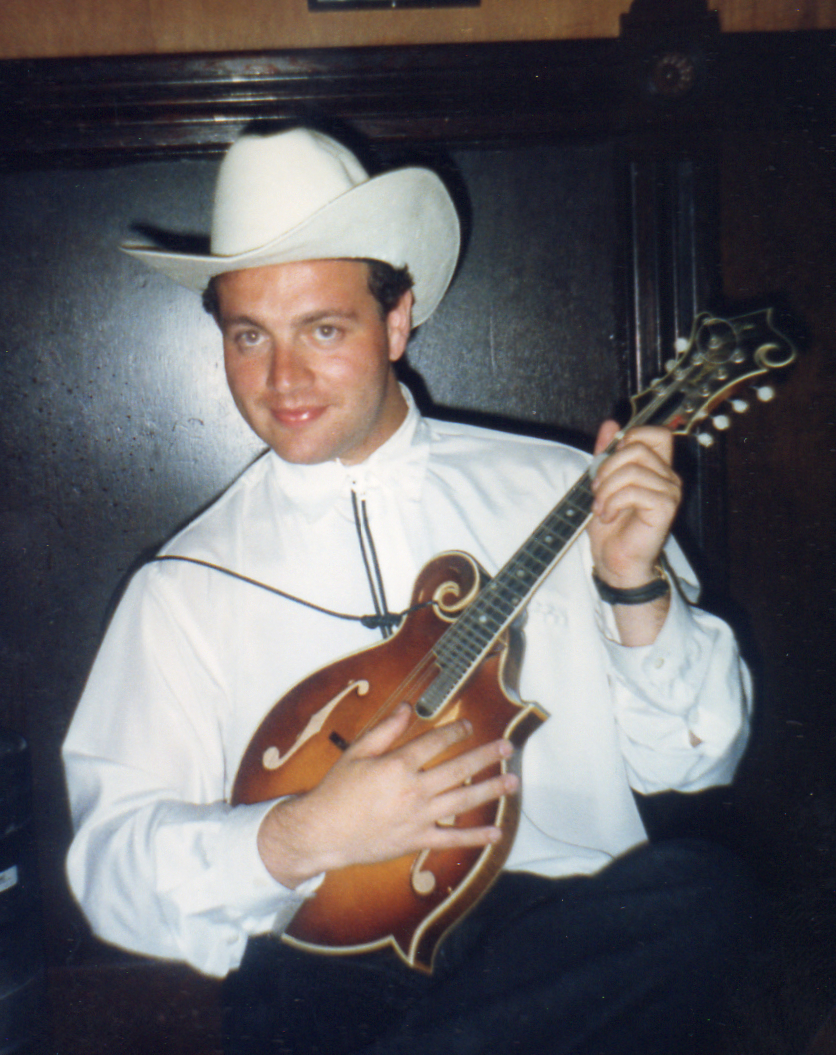
Instead of just singing, the duo delighted the audience by buck dancing and doing a quick do-si-do together right on stage. In 1991 I crossed the United States from coast to coast, passing through places like Tennessee (Nashville), Texas, and Louisiana, ending up in San Francisco, where I attended a Bluegrass concert. Here is the photo with the instrument lent to me by the band’s mandolinist, whose name, unfortunately, I don’t remember.
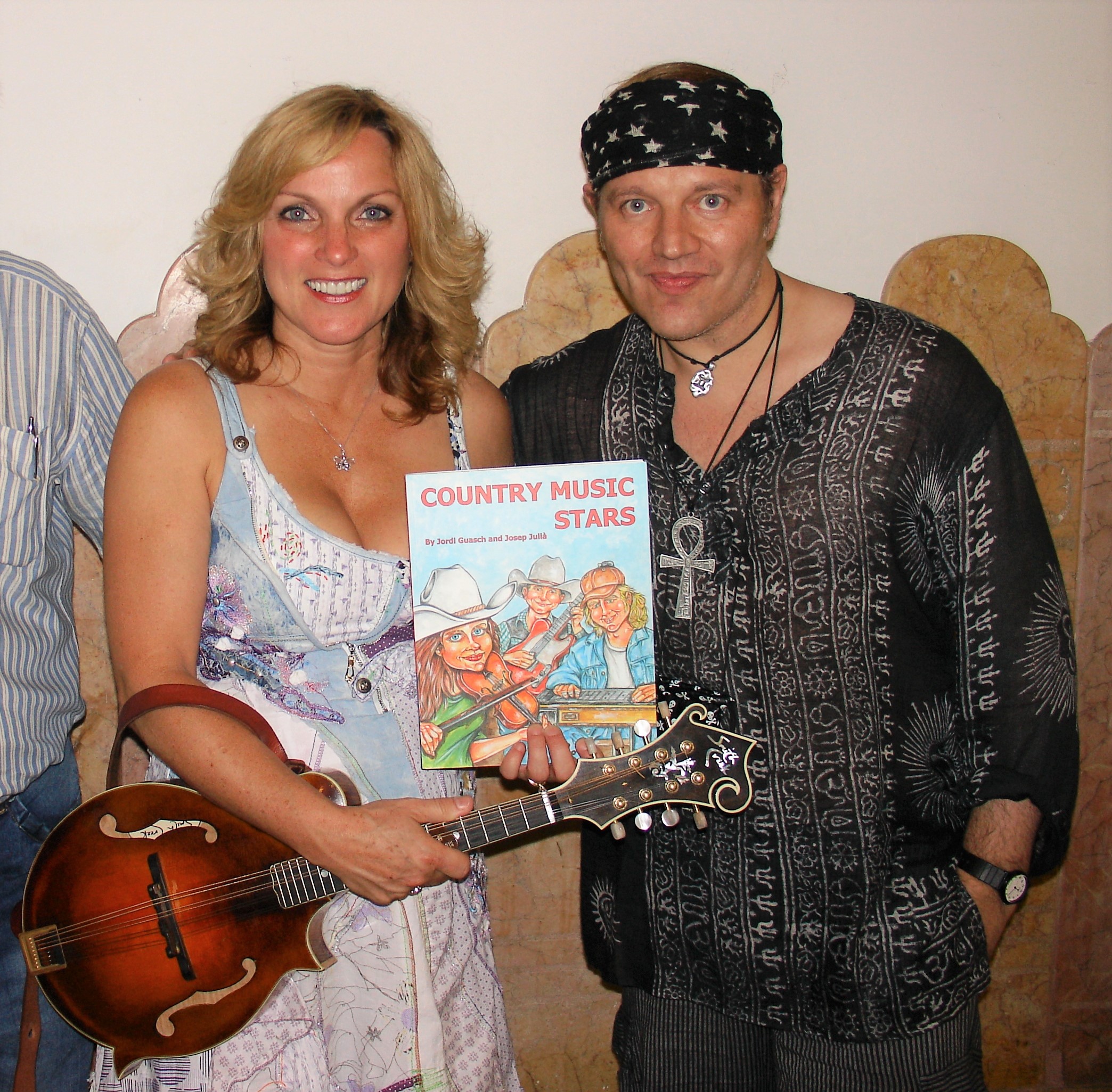
Over the years, I have been able to enjoy watching performances by many Bluegrass bands, including classics of the style, and obviously the father of the genre himself. One of the latest experiences was sharing a jam session in Barcelona with Rhonda Vincent, one of the best contemporary artists not only in bluegrass but in country music in general. Here I am with Rhonda Vincent. She loved the Country Music Star book and asked to buy all the copies we could provide her with.
Yes, as Bill Monroe said, Bluegrass is wonderful music! And, of course, it also has its spiritual side, such as Gregorian chant.