Jordi Guasch
Barcelona, Spain
Editor’s Introduction – James E Akenson
This discussion by Jordi Guasch deals with a very significant artist in the early development of Country Music. Charlie Poole doesn’t loom as large in the Country Music historical memory as “The Big Bang of Country Music” with Jimmie Rodgers and the Carter Family.
 Charlie Poole, though, is definitely not forgotten. The annual Charlie Poole Festival took place 12-14 June 2026 in Wentworth, North Carolina at Rockingham Community College. There have been Charlie Poole focused conferences. In 2005, the Southern Folklife Collection sponsored “Dynamic Legacies: Charlie Poole and the Evolution and Transmission of the Southern String Band Tradition.”
Just do an internet search for Charlie Poole. From Wikipedia to Spotify, Doscogs, and YouTube much less the sources cited by Jordi Guasch, Charlie Poole legacy has substance as well as flamboyance.
It is interesting how Jordi Guasch comes to know and investigate Country Music artists and themes as diverse as Charlie Poole. Living in Barcelona, Spain means that Guasch doesn’t have the ease of contact with Country Music on a daily basis.
There isn’t the Country Giant 94.7 radio station playing Country Music all day, every day. I keep up easily with just the varied programing by the Country Giant in Cookeville, Tennessee. And, there’s lots of other sources all around me. Plus there are varied academic conferences dealing with Country Music. Each year, I’m involved with the International Country Music Conference .
Yet, Jordi Guasch has learned a great deal about Country Music despite that Barcelona isn’t exactly Nashville. He began developing his Country Music knowledge before the ease of the internet, Spotify, and YouTube.
You’ll notice that Jordi Guasch uses significant sources about Charlie Poole. He uses Kenny Rorrer’s Rambling Blues: The Life and Songs of Charlie Poole. He also uses powerhouse Tony Russell as a source. Guasch finds the older Country Music particularly interesting.
He takes time to define the term Old Time Country Music. Guasch has a knack for finding unusual topics in Country Music. I find Charlie Poole fascinating on two levels. First, Charlie Poole clearly made a major contribution to early Country Music. Second, it’s amazing that he managed to live as long as he did.
Yes. Thirty-one isn’t a long life, but his lifestyle was over-the-top. Charlie Poole didn’t have much restraint on any level. Often, short careers with a tragic ending create a mythology, a niche in the historical memory of a genre.
Poole is remembered, but not with the magnitude of early death for Jimmie Rodgers, and Patsy Cline. We won’t mention pop and rock stars who died early and tragically, History sometimes isn’t fair in who it remembers or forgets.
Nevertheless, you will find that Jordi Guasch helps bring Charlie Poole into your historical memory.
If the river was whiskey and I was a duck
I´d dive to the bottom and I´d never come up
As Kinney Rorrer said, Poole´s reputation for consumption of beverages produced by the “cottage industries” of the Blue Ridge Mountains is certainly legendary and he could most assuredly sing the previous verse of If The River Was Whiskey with great authority and conviction. However, there was a price to pay. It took his life at a young age.
The older a country song is, the more I like and am moved by it. Perhaps it’s due to karma! I am interested in reviving the memory of great artists such as Charlie Poole. An article is barely enough for an introduction to this great singer and banjo player, but I hope it serves as recognition of his contribution to country music.
I recommend reading Rambling Blues; The Life & Songs of Charlie Poole (Kinney Rorrer). Unfortunately, we do not have a time machine to know what the country music songs and melodies of the early pioneers sounded like.
It began in the 17th century, based on what the first settlers brought over from the British Isles. However, we have the earliest recordings, and initially, performers practiced various facets of country music what they had inherited from the past. Charlie Poole was one of the best old-time artists.
Old-Time is the term often applied the oldest country music. Old-Time includes Country Music’s roots in the 17th century to the Great Depression. Old Time followed two paths. One path continued its development by adapting to the times based on its own traditional foundation. The second path resulted in the creation of specific, labeled styles within the genre such as Bluegrass.
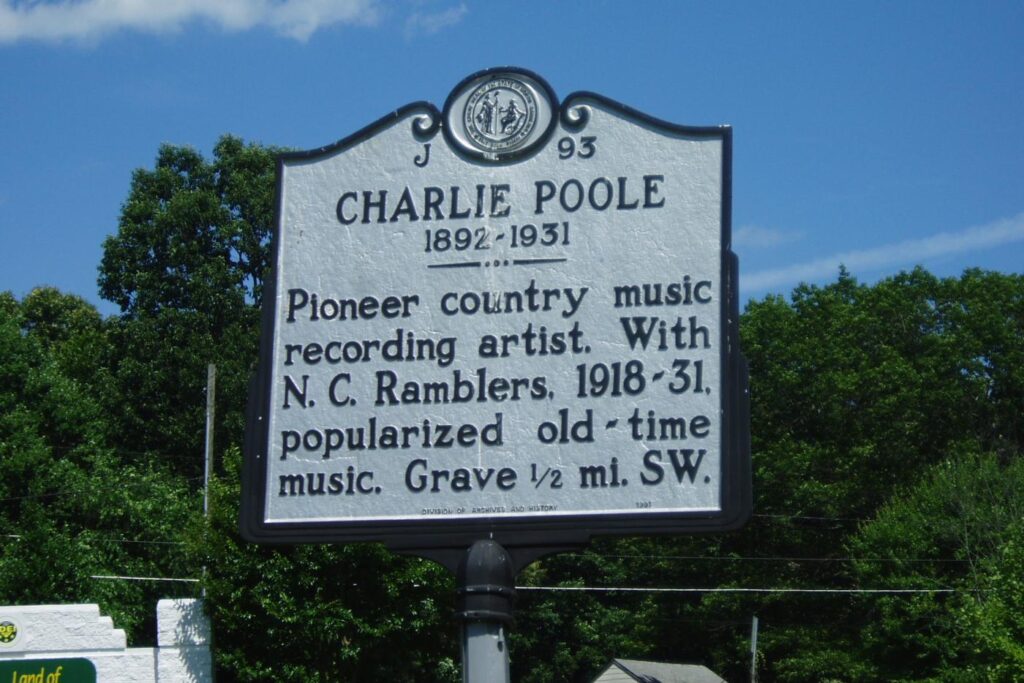
Of the hundreds of stringband musicians who recorded during the “Golden Age” of country music, in the 1920s and ´30s, only a few stand out as larger-than-life figures. One of those figures was Charlie Poole, “The North Carolina Rambler”. His recording career lasted only five years, from 1925 to 1930.
The wealth of songs and stories that he left has been enjoyed by fans of Old-Time country music for over half a century. Even today his influence can be found in traditional country and bluegrass style.
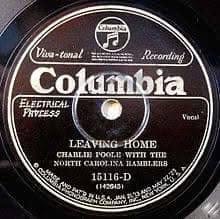 Many songs that were first recorded as country tunes by Poole and his circle of musical pals can be found in the repertoire of such singers as Roy Acuff, Bill Monroe, Ralph Stanley, Grandpa jones, Mac Wiseman and others. Perhaps more important than his dissemination of country songs was his development and popularisation of a three-finger banjo style that would evolve, a generation later, into bluegrass.
Charlie Poole (1892-1931), as Tony Russell said, was a hard-drinking banjo picker and one of the first legends of commercial Country Music. ‘Consider yourself under arrest!’ said one of the policemen as they burst into the bootlegging joint. ‘Consider Hell!’ said the banjo player. He slammed his instrument down over the cop´s head so that the neck hung down in front like a tie.
Another policeman shoved a gun into the banjo man´s ear. The musician forced it aside as it went off, chipping his teeth. Infuriated, he seized a walking stick and knocked several cops through the windows before leaping into a car and heading for the mountains.
An everyday story, maybe elaborted, in the life of Charlie Poole, old-time singer, banjoist and hellraiser, as Tony Russell describes him.
People in the old cotton mills towns of North Carolina and Virginia still remember Poole. Why? His kind of music. His manner, clipped and rough, belongs to another era. But he was one of a kind.
He told stories of the sweet 16 year-old who couldn´t stop chewing gum or the terrible boarding house where the baby had its feet in the soup. Or hear him in sentimental vein on a wistful song of parted lovers like Budded Rose or remembering childhood on Sweet Sunny South.
Charlie Poole was born in North Carolina in 1892 and began playing banjo before he was a teenager. By the time he moved to Spray in his mid-20s he was a seasoned picker. Spray and adjoining Leaksville and Draper boasted some remarkable musicians.
They included Posey Rorer and Norman Woodlieff, the first recorded line-up of Poole´s North Carolina Ramblers. Their 1925 debut Don´t Let Your Deal Go Down Blues/Can I Sleep In Your Barn Tonight Mister? sold over100,000 copies.Poole went on to record over 70 songs.
As well as rough cut versions of parlour ballads he liked to sing comic vaudeville material. Monkey On A String may seem strange to those who only know the most modern facets of the genre.
 Like Jimmie Rodgers, Poole aimed to play his way out of Country Music and into something more respectable and recorded some ragtime banjo solos. The venture failed. Poole went back to what he did best.
He rambled through Appalachia playing for mill workers and coal miners, in bootleggers joints and red light districts, and at high school graduations. But in 1931, with the Depression deepening, he had no recording contract, few bookings and a moonshine monkey on his back.
One morning in May 1931 a couple of his buddies found Poole clutching the railing outside the Spray post office. ‘Old Charlie´s sung all night long´he muttered. ´But this time old Charlie´s gonna kick the bucket.’
He weaved his way to his sister´s house. That evening he had a heart attack and died. Kinney Rorrer said that as his recording career freed him from cotton mill work, Poole´s rambling ways became more intense and ultimately self-destructive.
The last half-dozen years of his life were filled with colorful and sometimes rowdy exploits that made him into a much beloved legend in the villages and hill country of Virginia, West Virginia, and North Carolina.
Stories of folktale quality still abound in the región. Besides breaking his banjo over a policeman´s head and beingshot in the mouth the stories abound. He jumped into a crate of eggs in a country store to win a bet against the owner.
He could dance on his hands and do acrobatic tricks on a chair while highly intoxícate. He fell out of a chair while playing for a mountain high school graduation. He flew a biplane through a farmer´s fence scattering livestock in all directions.
Some tales were about whiskey and fights. Other stories showed kindness such as taking time to play music for a little blind girl or flipping a silver dollar to a small street urchin so he could go to the circus.
Totally, partially, or symbolically true, the stories testified to his forceful personality. A niece of Poole’s once described her uncle by saying “…he was a real individual-one of a kind. He talked ninety miles an hour and patted his foot the whole time he was talking. Why he would even sing you the answer to a question some times”.
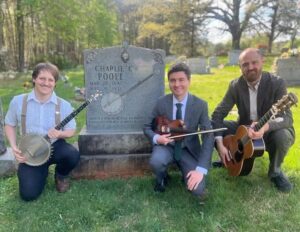
Even in death Charlie Poole created a folktale. A drunken mourner broke up his funeral by crying profanities at his grieving loss of ‘ dear old Charlie’ crying out a profane description of Charlie´s banjo-picking talents.
Though Charlie Poole died in 1931 at the age of thirty-one, he left a long-term legacy of great Old-Time music. His snappy singing and masterful three-finger banjo playing are timeless examples of Old-Time Country Music at its very best. Not only did he leave us some great songs but he also left us some great stories.
Judging by the lines from his songs, he would have wanted it that way.