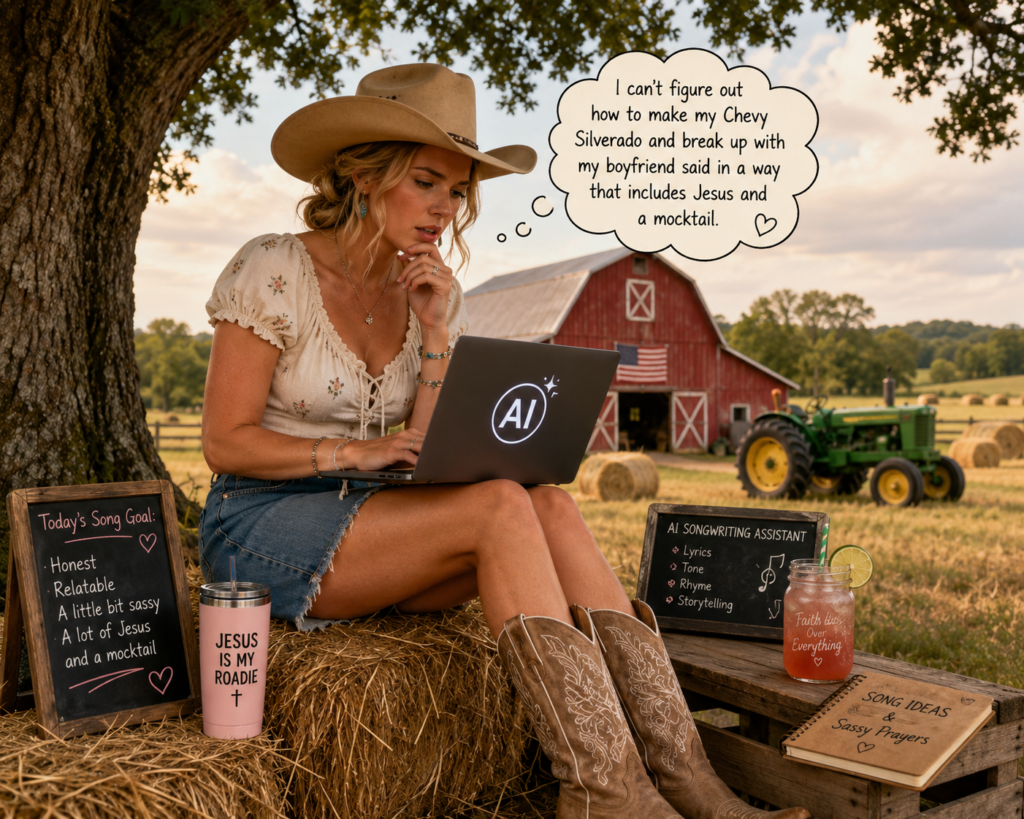
The Fine Line Between Innovation and Authenticity
Dr Larissa Rector
Cookeville, Tennessee
Editor’s Introduction – James E Akenson
Artificial intelligence (Ai) emerged in recent years as a powerful force for almost every from of human activity. We won’t worry about the impact of Ai on the environment or the loss of jobs in this discussion. Let’s just say that the environment and jobs are very reasonable concerns. The growing resistance to Data Centers should please many Ai sceptics.
This piece by Dr. Larissa Rector will focus on her thoughts about the impact of Ai on Country Music and it’s connection to Authenticity. Yes. I’ll capitalize Authenticity as it is a major concept in so many ways.
First, how do I know Dr. Larissa Rector? Before retiring from Tennessee Tech University I had the pleasure of teaching PhD level courses, serving on PhD committes, and attending numerous PhD prospectus and PhD defense presentations. Larissa Rector studied the Literacy Concentration. During a spring semester, I sat in on an advanced quantitative PhD course to increase my familiarity with statistical concepts such as regression analysis. Larissa Rector commuted one hundred miles each way to attend the course.
As a Literacy Concentration specialist Larissa Rector didn’t get to take my PhD course on Country Music. Sad! But…she always had an interest in Country Music and songwriting. Since completing her PhD, Larissa Rector continues to work in education, but is also intrigued by Country Music and songwriting. She sets forth interesting thoughts on the nature of Authenticity and the role that Ai may play in the creation of Country Music.
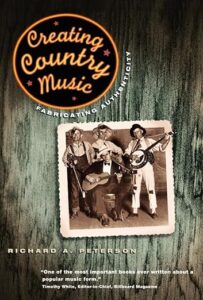
 Second, the concept of Authenticity is major. It’s everywhere including grocery stores like Kroger where I shop every week. Check out the pic. Authenticity is supremely important in Country Music. Richard Peterson’s Creating Country Music: Fabricating Authentiity sets the standard for Authenticity. Peterson said that Authenticity “is created and agreed upon over time….is a socially-agreed upon construct in which the past is misremembered.”
 Authenticity is a complicated abstract concept. It may be abstract but it is real in the minds of everyone interested in Country Music…. fans, artists, scholars, journalists…you name it. If it’s real Country Music, it’s Authentic. Does everyone agree if an artist or song is real Authentic Country Music. No. It’s a bit like Aussie Adam Harvey’s song that proclaims “beauty is in the eye of the beer holder.” There’s a lot more to Authenticity but you get the idea. It means Country Music is real in the mind of the County Music fan.
Third, Larissa Rector raises concerns about the impact of Ai on the Authenticity of Country Music. Ai can do all sorts of things. It can create lyrics from a songwriter’s basic idea. It can create melodies. It can provide specific instrumental accompaniment. It’s astonishing.

Let’s play “devil’s advocate” to this serious Authenticity question. At what point is an artist and songwriter creating and performing a real human creation? At what point is a Country Music artist like Ava Bently not a real Country Music artist? Check her out. She is the “world’s first female Ai powered country artist created using innovative Ai platforms.” She also claims there is “…authentic human creativity…”
“If a Country Music song is Ai generated but Country Music fans like it and feel it’s Authentic..isn’t it Authentic?” If the steel guitar and fiddle are Ai generated and it adds to make it feel Authentic to the Country Music fan… isn’t it Authentic Country Music? If the Country Music artist is an Ai generated image yet the Country Music fan feels it’s Authentic Country music… isn’t it Authentic? There are lots of Ai Authenticity questions. Ai makes a tricky concept like Authenticity all the more problematical.
Me? I want real Down Home Country Music completely created by real people. A line from a classic Country Music song might be appropriate….“I don’t think Hank done it that way.” Then again, the genie is out of the bottle. Authenticity may well be entering a new Country Music territory.
So…sit back and see how Dr. Larissa Rector views the Ai and Country Music landscape at this stage of her thinking. No doubt she will be developing her ideas into substantially longer, more detailed, discussions in the future. Enjoy!
Artificial Intelligence and Country Music – Larissa Rector
Country music has always been a genre rooted in storytelling. Long before streaming services, social media algorithms, and artificial intelligence entered the conversation, country songs were built from human experience. They were written from heartbreak, hard work, faith, family, struggle, loss, and triumph. They reflected the lives of ordinary people and transformed those experiences into melodies that could unite millions.
Today however, country music stands at a crossroads. Artificial Intelligence (AI) is rapidly changing the way songs are written, recorded, marketed, and consumed. Some see these developments as exciting innovations capable of unlocking new levels of creativity. Others worry that the very technology designed to assist artists could slowly replace the human element that made country music special in the first place.
The debate surrounding AI in country music is not simply about technology. It is about identity. It is about authenticity. Most importantly, it is about what happens when human creativity begins competing with machines designed to imitate it.
At its core, country music has always been about real people telling real stories. Whether it was the dust-covered highways of classic country, the blue-collar struggles of the 1990s, or the modern fusion of country and pop influences, listeners connected with artists because they believed the stories being told.
Artificial intelligence introduces a fascinating challenge to that relationship. Today, AI can generate lyrics, compose melodies, create vocal performances, recommend song structures, and analyze listener preferences with remarkable accuracy. A songwriter can enter a few prompts and receive verses, choruses, and hooks within seconds. Record labels can use algorithms to predict trends before they happen. Streaming platforms can determine what style of music is most likely to succeed based on listener behavior.
In many ways, this sounds efficient. Perhaps even revolutionary—but efficiency has never been the reason people fall in love with country music. No algorithm understands what it feels like to watch your child graduate. No machine truly understands the heartbreak of a divorce, the pride of a first paycheck, the grief of losing a loved one, or the joy of returning home after years away. AI can analyze millions of examples of those emotions, but it cannot live them. And that distinction matters.
One of the growing concerns among musicians and listeners alike is that society is beginning to treat people the same way it treats technology: as systems to be optimized, streamlined, and programmed. In many ways, we risk becoming replaceable machines ourselves—molded into whatever society, technology, or the marketplace decides we should become increasingly standardized. The question then becomes: Are we creating music, or are we creating products?
Country music has historically thrived because artists were willing to be different. They were willing to be the voices that shaped the genre, often succeeded precisely because they did not fit neatly into a formula. They brought their own imperfections, perspectives, and experiences to the table.
Instead of encouraging individuality, modern culture often rewards conformity. Algorithms tell us what to watch, what to buy, what to listen to, and even what opinions are likely to generate attention. As artificial intelligence becomes more influential, there is a danger that creativity itself could become.
AI, on the other hand, is fundamentally designed to identify patterns. It learns from what already exists. It recognizes trends. It predicts outcomes. While that ability can be incredibly useful, it can also encourage a world where originality becomes harder to find. If every song is optimized for maximum engagement, maximum streams, and maximum profitability, something important may be lost. The rough edges. The imperfections. The unexpected moments that make music feel human. The pain behind the words. The healing in the melody. The true, raw, life-changing and life-altering music.
This concern extends beyond songwriting. Artificial intelligence is now capable of creating realistic vocal performances that can mimic artists with astonishing accuracy. It can generate images, videos, and digital personalities that appear authentic even when they are entirely synthetic. As these technologies improve, audiences may find themselves asking increasingly difficult questions. Who created this song? Who sang these words? Who is actually behind the face on the screen?
The rise of AI-generated personalities offers a glimpse into this new reality. Individuals such as Ava Bently are becoming associated with a growing movement in which technology, branding, and artificial intelligence intersect. Whether viewed as innovators, influencers, or symbols of a changing digital landscape, figures like Bently represent an era where the distinction between human identity and technological creation is becoming increasingly blurred.
For younger generations especially, AI-generated personalities may become as familiar as traditional celebrities. They can exist around the clock, adapt instantly to trends, and interact with audiences at a scale that would be impossible for most humans.
That possibility is both fascinating and unsettling. On one hand, it demonstrates the extraordinary capabilities of modern technology. On the other, it raises important questions about authenticity and human connection. If audiences can form relationships with digital personalities, what does that mean for artists whose appeal has always been rooted in genuine lived experience?
Country music may be uniquely positioned to answer that question. Unlike many forms of entertainment, country music has long placed a premium on authenticity. Fans often care just as much about an artist’s story as they do about the songs themselves. They want to know where an artist came from, what they believe, what they’ve endured, and what inspires them.
That human connection cannot be easily replicated. A machine may be able to write a convincing breakup song, but it cannot sit on a porch remembering a love that slipped away. It cannot stand backstage nervous before a career-defining performance. It cannot experience the emotions that give art its meaning. What it can do is assist. And perhaps that is where the conversation should focus.
The future of AI in country music does not have to be a battle between humans and machines. It does not have to be an either-or proposition. Instead, it can become a partnership that amplifies human creativity rather than replacing it. Imagine a songwriter using AI to overcome writer’s block while still contributing the emotional core of the song. Imagine independent artists gaining access to production tools that were once available only to major record labels. Imagine musicians experimenting with new sounds, arrangements, and ideas that might never have emerged otherwise. These possibilities are not threats to creativity. They are opportunities.
Throughout history, every major technological advancement has sparked fear. Radio was once viewed as a threat to live performance. Recording technology changed the music industry forever. Digital streaming transformed how artists reached audiences. Social media altered the relationship between performers and fans. Yet despite all of those changes, one thing remained constant: people still craved authentic stories. And like it or not, artificial intelligence is unlikely to change that reality. The most successful country songs of the future will probably not be the ones written entirely by machines. They will be the ones that use technology as a tool while preserving the humanity that listeners continue to seek.
The challenge for artists will be resisting the temptation to allow technology to define them. The challenge for listeners will be remembering that convenience and authenticity are not always the same thing. And the challenge for the industry will be finding a balance between innovation and integrity.
At its best, country music reminds us what it means to be human. It tells stories about love, loss, hope, resilience, and redemption. Those themes have survived every cultural shift imaginable because they are woven into the human experience itself.
While AI may transform the tools we use to create music, it cannot replace the heart that gives music meaning. The future of country music does not belong solely to algorithms, machines, or artificial intelligence. It belongs to the songwriters, musicians, dreamers, and storytellers who continue to bring their unique perspectives into the world.
AI is not necessarily here to replace talent. It is not destined to erase creativity or diminish the gifts that artists possess. When used responsibly, it can become something far more valuable: an aid rather than a substitute. A collaborator rather than a competitor.
Used wisely, AI can help artists write more efficiently, explore new ideas, refine their craft, and expand their creative horizons. It can increase productivity while still preserving individuality. It can provide inspiration without becoming the source of inspiration itself.
The future should not be about choosing between humanity and technology. It should be about ensuring that technology remains a tool in the hands of creative people rather than creative people becoming tools of technology.
Because no matter how advanced artificial intelligence becomes, the world will always need something only humans can provide: genuine stories told from genuine lives.