Extending the Historical Record Via PragueFrank’s Discographies
INTRODUCTION
Gaps in the Historical Record
Michel Ruppli’s name is synonymous with a series of comprehensive multi-volume hardback discographies that encompass some of the most prized and prestigious American record catalogs of the twentieth century, including Atlantic, Decca, Mercury, MGM, Chess, and King. In the years following the release of these print publications, some missing discographical details — musical personnel, recording dates, and geographical locations — have since come to light.
This paper demonstrates how supplemental reference sources, both online and print, can be harnessed to augment the historical record connected to the King labels that has been so diligently organized by Ruppli, in partnership with Bill Daniels. This same methodology is then employed to fill some missing recording session details in Mercury Records’ own country music history, thus demonstrating the need for additional research of this type to extend the discographical framework established by Ruppli and his associates, particularly those music labels with a country catalog.
FILLING KING HISTORY’S GAPS
The PragueFrank Research Collective
The King Labels: A Discography was originally published in 1985 by Greenwood Press as a two-volume hardback set, with Volume one focused on King releases, while Volume two addressed the associated labels (Federal, DeLuxe, and Bethlehem), as well as other labels distributed by King (Beltone, Fairlane, 4 Star/Gilt-Edge, Willow, Huron, and others).
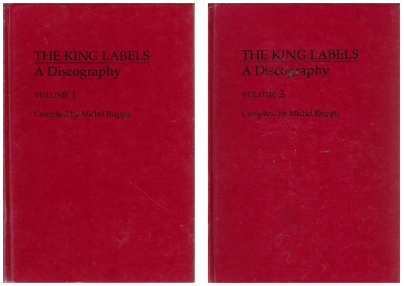
After I acquired my own copy, I remember being taken back, initially, by the sparseness of information within the first one hundred or so pages beyond simply the song titles. However, with the advent of the world wide web, supplemental assistance would eventually arrive in the form of an extensive series of country music discographies compiled by a European collective of scholars and musicologists — including, unsurprisingly, Michel Ruppli — who post under the banner of “PragueFrank,” one of the group’s members.

The relative minimalism of The King Label‘s first 100 pages — when viewed in a more constructive frame of mind, I came to realize — presented an invaluable learning opportunity. That is, thanks to the critical collection of recording information scattered among a multitude of PragueFrank’s Country Music Discographies, I have been able to compile a sizeable chunk of the session data related to King’s early country era that is missing from my own print copy of the Ruppli “red books.” As a result of this do-it-yourself research project, my “enhanced” hardback has become a one-of-a-kind compilation of King Records recording info.
The King Labels
Volume 1 – page 1
King’s first recording sessions
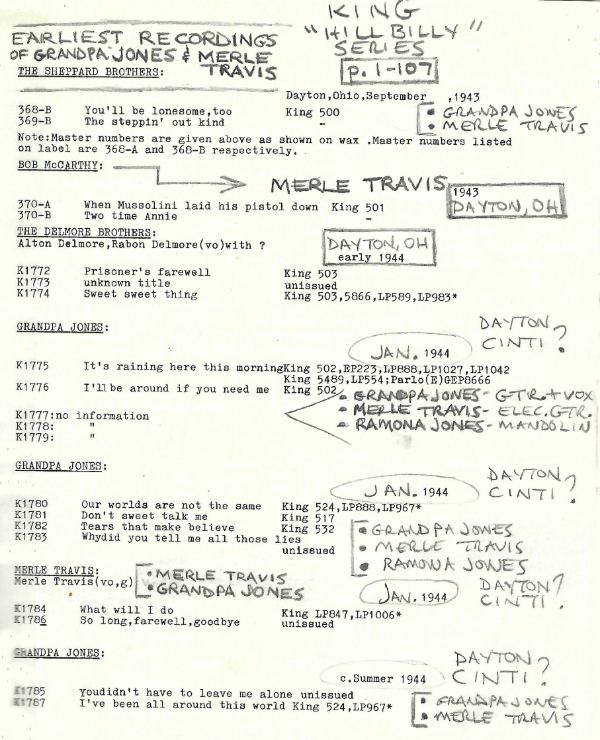
What helped me to “see the light” about the rich research potential afforded by these lightly-populated pages in Volume 1 was a transcontinental partnership I had forged a few years earlier with Walter Stettner of Austria — a fellow steel guitar fanatic, who oversees the Lloyd Green tribute website — when the two of us teamed up to identify each and every recording made by bandleader and legendary musician, Jerry Byrd, during his residency in Cincinnati as a staff musician at WLW, who also did plenty of side work as a studio session player.
In the course of compiling research for 2022’s history piece, “The ‘Pre-Nashville A Team‘ at Cincinnati’s Herzog Studios,” Stettner and I were able to utilize session details from the various PragueFrank Country Music Discographies in order to make determinations of responsibility regarding one of the earliest country music session player “A Teams,” The Pleasant Valley Boys — Jerry Byrd (steel guitar), Zeke Turner (lead guitar) Louis Innis (rhythm guitar/bass), and Tommy Jackson (fiddle) — and their involvement at recording sessions that took place at Herzog, as well as King Studios during the late 1940s/early 1950s, at a time when WLW’s robust wages had prompted these Nashville musicians to relocate to Cincinnati.
The thrill of extending the historical record in collaboration with a fellow music researcher – whom I never actually met – subsequently inspired me to begin fleshing out my own personal copy of Ruppli’s King session notes by hand, one artist at a time, adding recording data lifted straight from the PragueFrank County Music Discographies.
Jerry Byrd & The Pleasant Valley Boys at King Studios
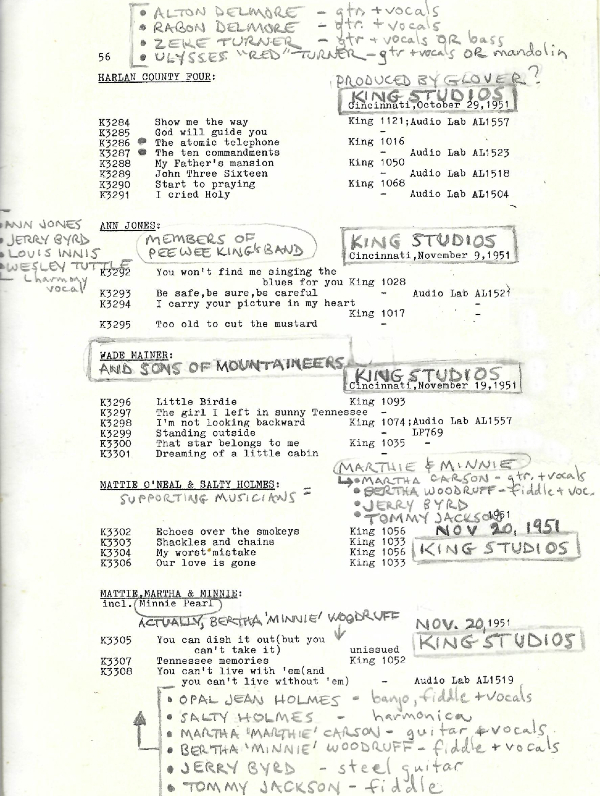
The King Labels
Volume 1 – page 56
FILLING KING HISTORY’S GAPS
Liner Notes from Recordings & Box Sets
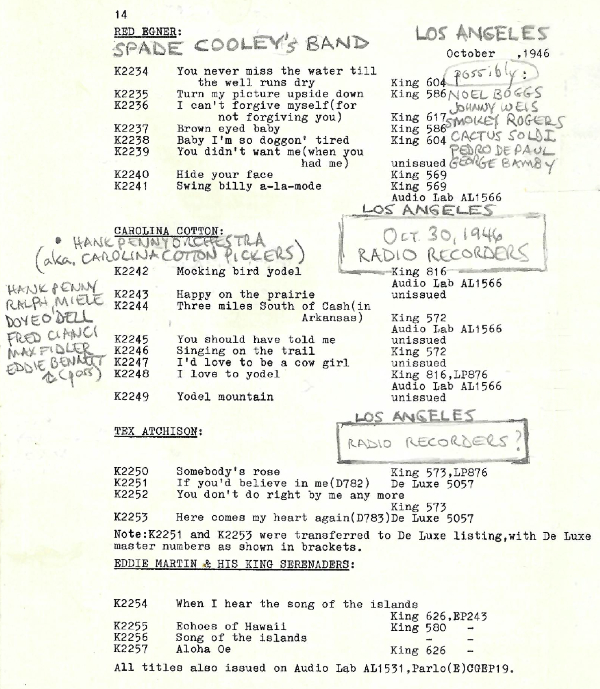
Recording details gleaned from liner notes that accompany CD reissues of King material from such respected labels as Ace UK, Bear Family, and Westside/Demon can also be tapped as a supplemental information source in helping to flesh out Ruppli’s historical record. For example, from Kevin Coffey‘s liner notes written for Shuffe Town – Western Swing on King, we now know that western swing bandleader Spade Cooley – who was under contract to Columbia Records at that time – cut sessions for King Records in October of 1946 “under vocalist Red Egner‘s name.” Ruppli’s recording notes are pretty sparse on the details, but PragueFrank’s discography for Spade Cooley, fortunately, names most of the musicians at this session, including harpist, Paul Featherstone, and stellar steel guitarist, Noel Boggs.
Red Egner + Spade Cooley’s Orchestra (uncredited)
The King Labels
Volume 1 – page 14
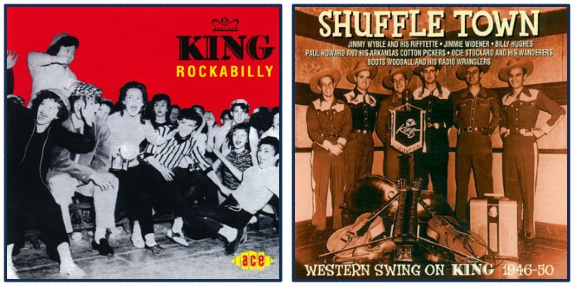
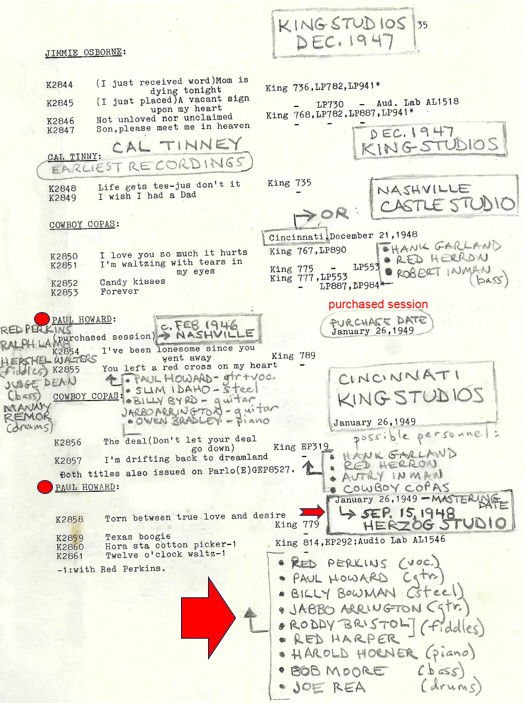
Rob Finnis‘ liner notes for Ace UK’s King Rockabilly also tell us that it was none other than Chet Atkins, who played bass on Fuller Todd’s “Proud Lady” when session bassist (and fellow “architect of the Nashville Sound“), Bob Moore, had not yet arrived at RCA Nashville, where the song (co-written by Louis Innis) was recorded on March 25, 1957. Kevin Coffey’s same Shuffe Town liner notes, furthermore, point out that Paul Howard And His Cotton Pickers‘ first session for King in January of 1949 was, in fact, Bob Moore “making his recording debut” — at Cincinnati’s Herzog Studio, according to PragueFrank’s discography of Paul Howard.
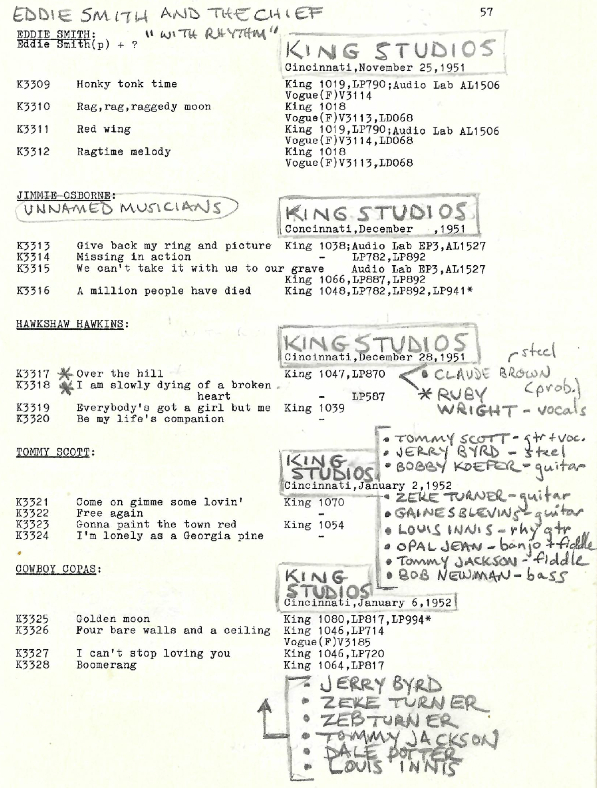
Tommy Scott, by way of another example, recorded briefly for King, who issued four of Scott’s eight singles on King’s Federal subsidiary label as part of its “Hillbilly Series.” Ruppli’s session notes for Tommy Scott’s Federal sides are bereft of musical personnel. However, Dave Sax‘s liner notes written for Ace UK’s King Hillbilly Bop ‘n’ Boogie helpfully inform us that Jerry Byrd (steel) and Tommy Jackson (fiddle) provide musical support on these tracks. PragueFrank’s discography of Tommy Scott goes a step further and names all known musicians at all four recording sessions for both Federal and King that took place between 1951 and 1952, including Bobby Koefer (guitar), Opal Jean (banjo & fiddle), Gaines Blevins (guitar & bass), Bob Newman (bass), and Louis Innis (rhythm guitar).
Paul Howard And His Cotton Pickers on King
The King Labels
Volume 1 – page 35
Tommy Scott on Federal & King
The King Labels
Volume 1 – page 57
FILLING KING HISTORY’S GAPS
Crowd-Sourced Websites
Sometimes, key contributors at “crowd-sourced” music websites, such as 78RPM, Discogs, and 45Cat, can help fill knowledge gaps. For instance, thanks to supplemental information posted on 78RPM by long-time contributor “fixbutte,” we know that a handful of King’s early single releases — King 502 (Grandpa Jones), King 503 (Delmore Brothers), King 504 (Carlisle Brothers), and King 505 (Cowboy ‘Pappy‘ Copas) had been re-recorded at least once, sometimes twice, and re-released each time issued on disc, however, using the same matrix numbers.
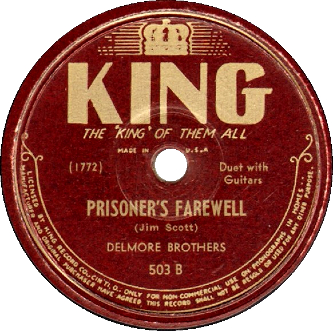
Historical notes posted on 78RPM with regard to King 503 — “Prisoner’s Farewell” b/w “Sweet Sweet Thing” by the Delmore Brothers — provide much needed clarity:
- First recorded Jan 1944, Dayton, OH (1st version).
- Re-recorded later in 1944, Dayton, OH (2nd version).
- Re-recorded again early 1945, King Studio, 1540 Brewster Avenue, Cincinnati, OH (3rd version).
- All versions used the same matrix numbers (1772 – Prisoner’s Farewell, 1774 – Sweet Sweet Thing).
- Second and third version have “Sweet Sweet Thing” as A-side and “Jim Scott” as composer (like “Jean Ruhe” a pseudonym for Alton Delmore).
Prisoner’s Farewell b/w Sweet Sweet Thing
2nd version
(released Dec. 1944)
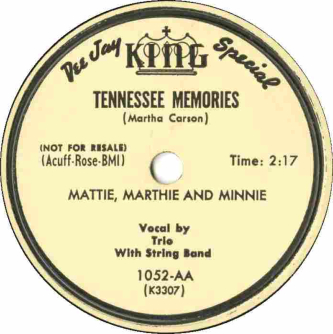
Historical notes posted on 78RPM also helpfully correct Ruppli’s mistaken assumption that Minnie Pearl was part of the vocal trio, Mattie, Marthie And Minnie, who recorded a single session in 1951 for King (illustrated above on page 56).
- Recorded November 20, 1951, King Studio, 1540 Brewster Avenue, Cincinnati, OH.
- Opal Jean “Mattie O’Neil” Amburgey (vocal, banjo, fiddle); Floyd Lee “Salty” Holmes (harmonica [& string bass]); Irene Ethel “Martha Carson” Amburgey-Roberts (vocal, rhythm guitar); Bertha “Minnie” Amburgey-Woodruff (vocal); Thomas Lee “Tommy” Jackson Jr. (fiddle); Gerald Lester “Jerry” Byrd (steel guitar).
FILLING KING HISTORY’S GAPS
Listening By Ear +/- Context Clues
One other useful tool that helps to expand our historical knowledge basis has been to employ the listen-by-ear technique when a musician possesses a distinctive playing style, especially when corroborating information is available that bolsters academic leaps of faith. By way of example, on page 49 of Michel Ruppli’s King session notes, there is a Shorty Long recording date that immediately follows Bob Newman’s February 5, 1951 session. Of the two songs recorded at this session, of particular interest is “Hillbilly Wedding” penned primarily by Henry Glover. Dolly Dimple, according to one 78 RPM contributor, “was actually Dolly Dimples, who had made her own records before and was married to Shorty Long until his death in Oct 1991.”
Shorty Long & Dolly Dimple on King
The King Labels
Volume 1 – page 49
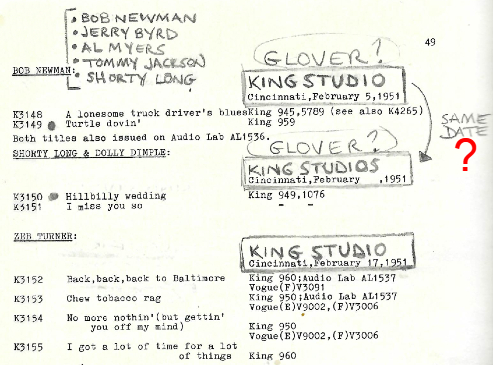
Q = Are the musicians on this track, particularly steel (Jerry Byrd) and lead guitar (Al Myers), the same players from the Bob Newman date?
Just from the sound of things – “Hillbilly Wedding” and “I Love You So” – I would bet big money that they are.
HARVESTING NEW RESEARCH FROM PRAGUEFRANK INFO
King Records’ Illustrious Steel Guitar Heritage
 After the first 100 pages of The King Labels – Vol. 1 had been systematically supplemented with recording details extracted from the respective PragueFrank discographies, I then seized on the idea of compiling a comprehensive chronology of each steel guitarist who ever recorded for the King labels, a veritable Who’s Who of early country music steel guitar that was posted in May of 2025.
“Notable Steel Guitarists Who Recorded for King Records” puts the spotlight on King recordings graced with steel guitar embellishments by the likes of Billy Strickland, Noel Boggs, “Joaquin” Murphy, Ralph Miele, “Jiggs” Lemley, Acie Peveto, Eddie Martin, “Slim” Idaho, Andy Schroder, “Boots” Woodall, Roy Honeycutt, Jewell Ayres, Billy Bowman, “Speedy” West, Herb Remington, Claude Brown, Bobby Koefer, Red Embry, Marian Hall, Don Helms, and Bud Isaacs.
PROBING PRAGUEFRANK DISCOGRAPHIES FOR HISTORIC DETAILS
Case Study #2
Mercury Records
Can PragueFrank’s Country Music Discographies be similarly mined to expand the historical record of other notable record labels with country catalogs? To test my hunch, I paid a visit to the Recorded Sound Research Center at the Library of Congress in Washington, DC. Given the amount of side session work performed by Jerry Byrd and the Pleasant Valley Boys at Cincinnati’s Herzog Studio between the late 1940s and early 1950s, I wanted to examine firsthand the Mercury Records discography published 1993 by Michel Ruppli and Ed Novitsky for completeness of detail, particularly as regards Byrd, “considered by many the number one guitar player in the country,” as Cash Box opined in 1953.
Because of the paucity of information for each taping session below that features Jerry Byrd as a Mercury recording artist, I have inserted additional pertinent recording details (outlined in red ink) that are taken directly from the PragueFrank discography of Jerry Byrd written by none other than Michel Ruppli in conjunction with Malcolm Rockwell. On all three recording sessions from 1949, it is historically significant to note that Byrd received musical support from The Pleasant Valley Boys: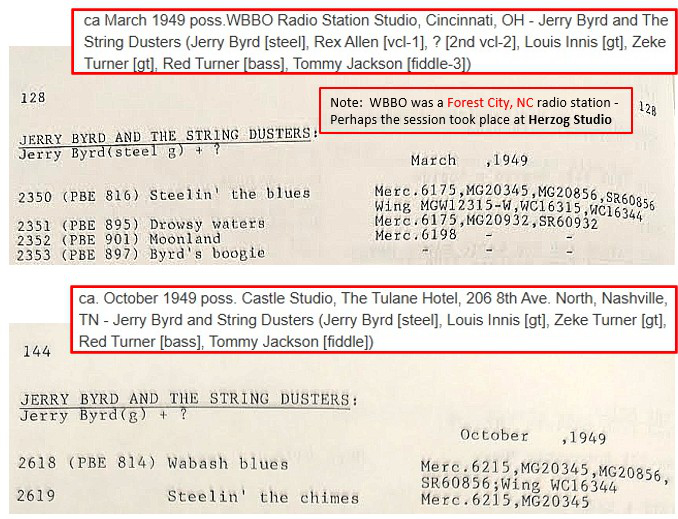
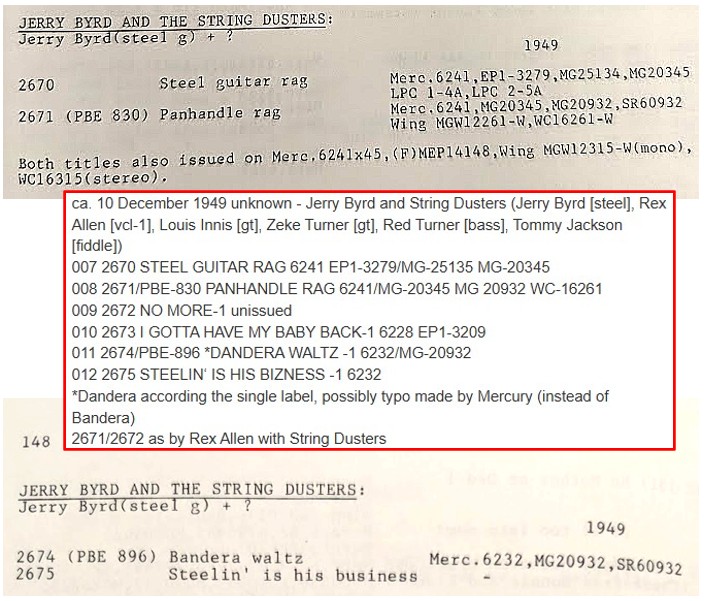
Note the qualifying notes (with an asterisk below) that acknowledge disagreement on recording date with Malcolm Rockwell, author of Discography of Hawaiian and Hawaiian Guitar Records 1891-1960.
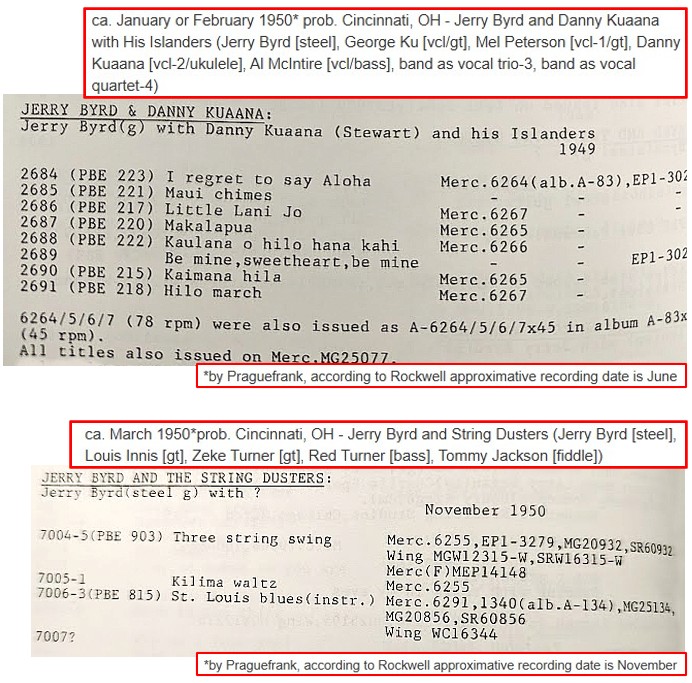
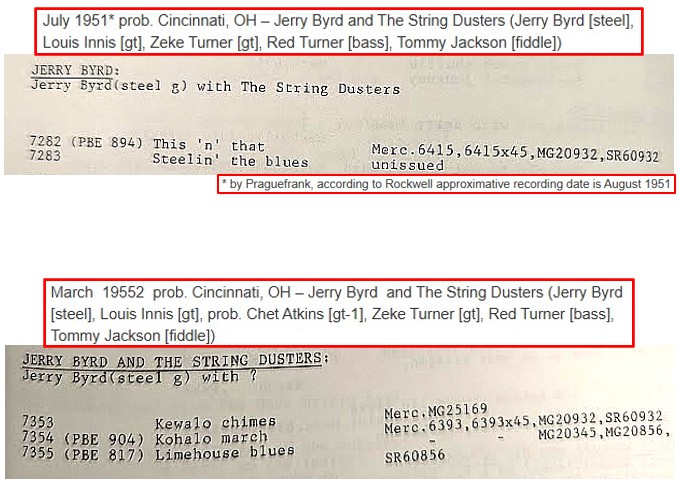
It is worth noting that the session listed below is the second “probable” appearance of Chet Atkins on a Jerry Byrd recording date. Additionally, on the song “Gold Coast Blues,” Malcolm Rockwell believes Jerry Byrd to be playing dual steel guitar parts via the early use of multi-track recording.
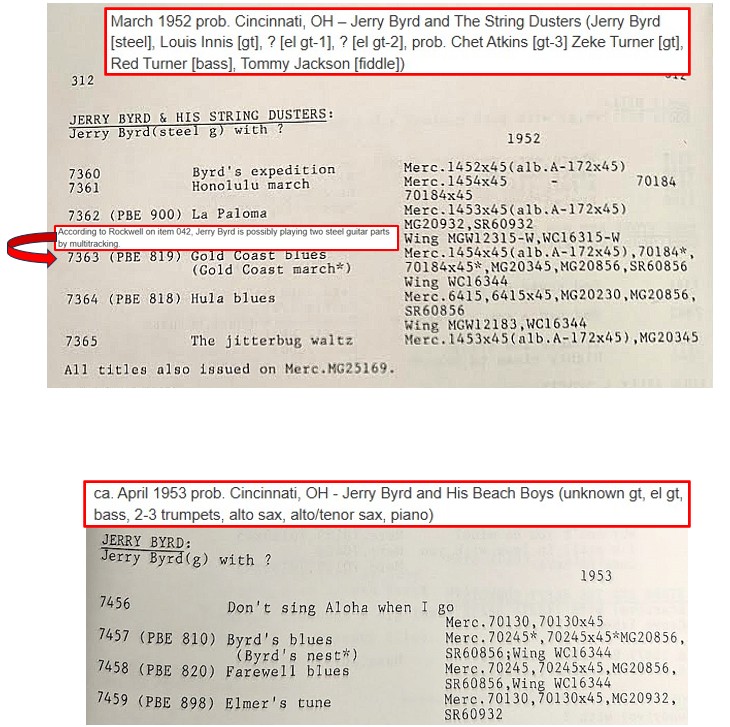
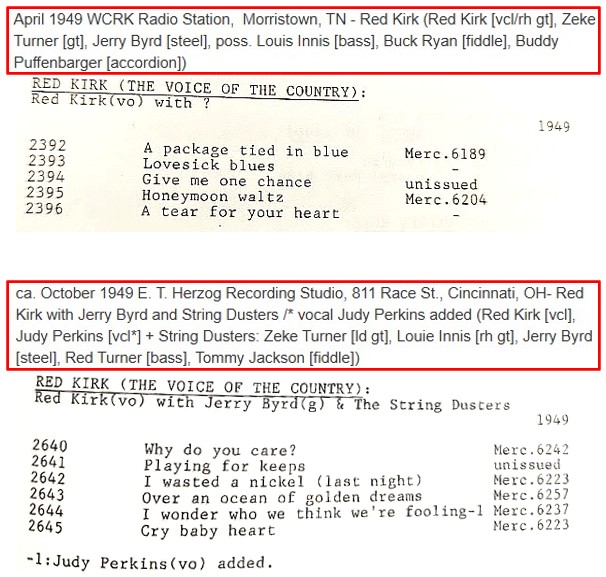
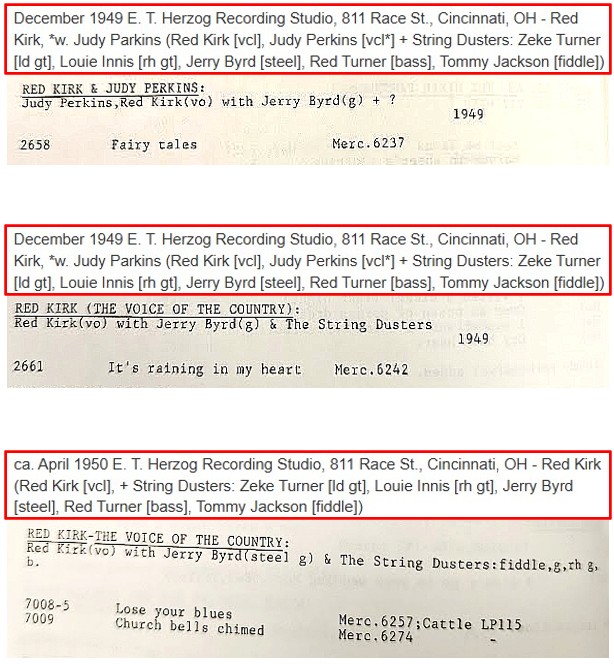
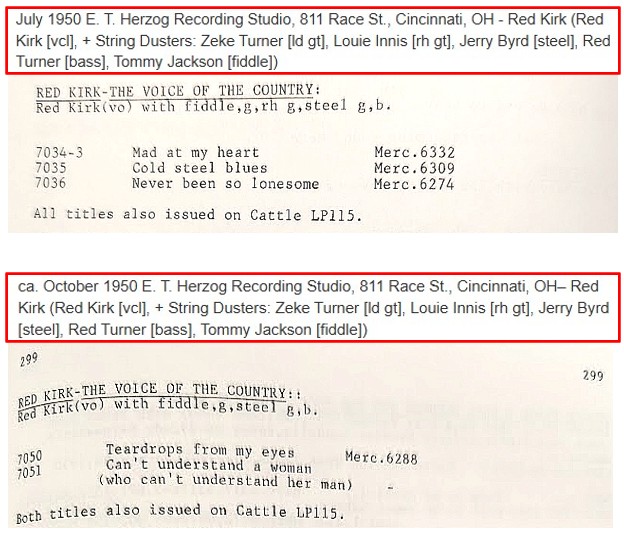
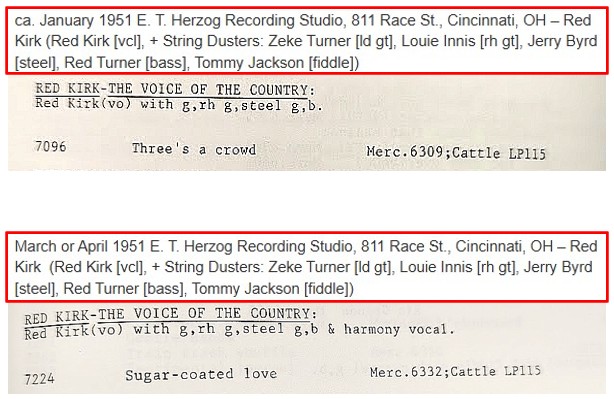
Likewise, when you scan all of Red Kirk‘s sessions for Mercury, you will encounter a similar scenario: an absence of recording details that, fortunately, were compiled later by Ruppli, PragueFrank, and Thieu Van De Vorst (outlined below in red ink) and posted on the PragueFrank Country Discographies website.
CONCLUSION
Methodology for Expanding the Historical Record
Michel Ruppli’s print discographies have provided a firm foundation that can be augmented and extended as additional research findings come to light. The methodology outlined above — supplementing Ruppli’s discographies with selected informational resources, both online and print — points a way forward for expanding the historical record. It is important, though, for the researcher to exercise judgment as to the credibility of the source whenever weighing the decision to incorporate historical notes from elsewhere.