Andrew Smith
Discographies are a valuable resource for country music collectors and researchers. Perhaps the most impressive in country music is Tony Russell’s Country Music Records: A Discography, 1921-1942, which lists every country music song recorded in the United States from 1921 to 1942.
 This book was an invaluable reference for my research on the Australian country singer Tex Morton because it listed Australian releases of songs originally recorded in America, some of which might have inspired Morton to record his own versions.
Later, I became interested in two Australian record labels: the Rodeo record label and Columbia Graphophone’s Regal Zonophone series, which boasted the largest catalog of country music outside the USA. For aspiring Australian country musicians of the 1940s and 1950s, having their records released on the Regal Zonophone label signified they had “made it.” Collectors Hedley Charles and David Crisp compiled the original discographies of these important labels. David Hardy (who wrote the Microsoft Word version of the Regal Zonophone database) and the late David Crisp provided me with hardcopy printouts of the Regal Zonophone and Rodeo discographies.
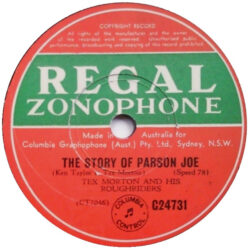
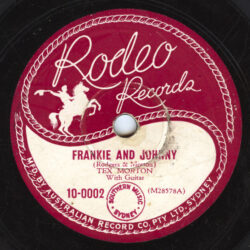
Tex Morton recorded for both the Regal Zonophone and Rodeo labels.
These “hardcopy” discographies were very useful, but collating information from them could be tedious, so I created two relational databases: one for the Regal Zonophone catalog; the other for the Rodeo label. This involved entering over one thousand song titles into database tables, since relational databases consist of tables of information that are linked to each other.
Another tool for storing information electronically is a spreadsheet (like Microsoft Excel), but these produce flat files, essentially one large table, lacking the data-handling capabilities of databases. Fortunately, databases can also generate flat files and most can export them to Excel or other spreadsheets as flat files, giving users the best of both worlds.
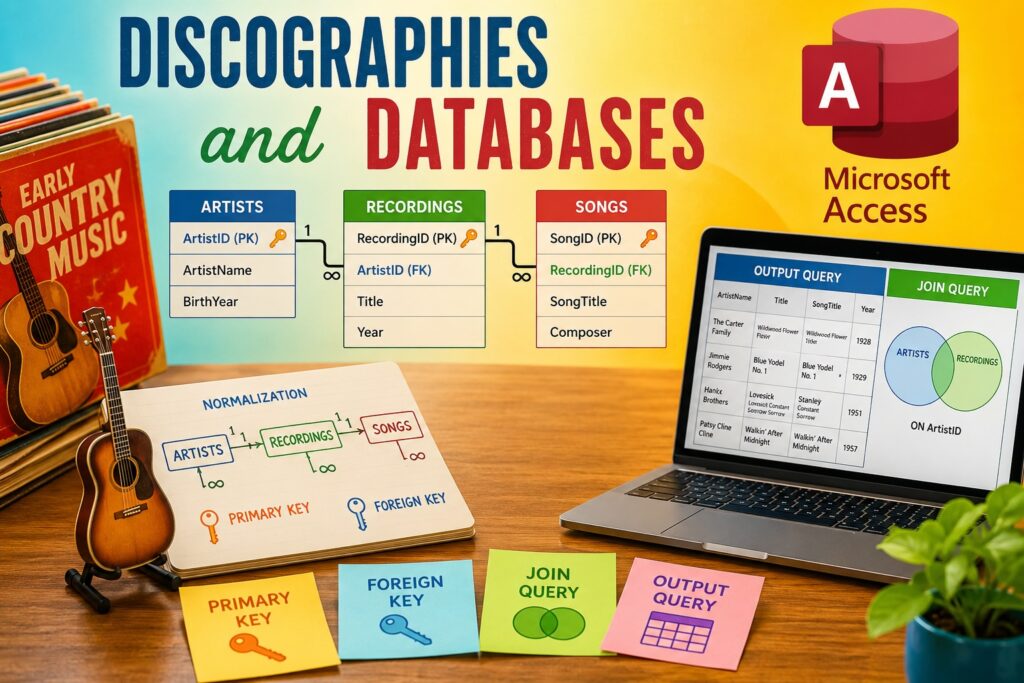
The first step in constructing a relational database is to design its tables. This is called normalizing the database. A goal is to achieve third normal form (3NF) or better. (There are various stages in normalizing databases: 3NF is generally considered “good.”)
Normalization is a systematic process in relational database design that organises data into structured tables to reduce redundancy (and hence memory requirements), and to improve data integrity. It involves decomposing large, unorganised tables into smaller ones, linked to one another through primary and foreign keys (usually IDs). I studied databases at university, where much of the course involved normalizing relational databases. Unfortunately, many “home-made” databases are poorly constructed, since anyone can construct databases without knowing anything about normalization.
What follows is a very simple explanation of the discography databases. There were other tables in the databases, but to keep things simple, I have discussed only some tables. Data in the explanations has been invented, but it’s comparable to “real-life” information. The database I used was Microsoft Access, but other database applications would be compatible.
The Artist Table
One of the first tables to be constructed was the Artist Table (see below).
| 1 | Vernon Dalhart | 1 |
| 2 | Jimmie Rodgers | 2 |
| 3 | Tex Morton | 3 |
| 4 | Al Craver | 1 |
| 5 | Tex Morton and Sister Dorrie | 3 |
| 6 | Carson Robison | 6 |
The first column (the primary key) comprises numerical identification codes (IDs) for all the artists in the database. The artists’ names (in the second column) are exactly as they appear on the record labels, to the best of my knowledge. Each primary key must be unique, so assigning numerical IDs is one of the simplest ways to achieve this.
The third column “points to” the actual artist whenever a nom de plume was used. Vernon Dalhart, for example, recorded under many names, such as “Al Craver.” In this case, the third column for “Al Craver” points to ID 1, which is associated with Vernon Dalhart.
Similarly, Tex Morton sometimes recorded with Dorothy Carroll (as “Sister Dorrie”), so the ID in the third column points to ID 3 (Tex Morton).
The Song Table
This table lists the songs in the database. Compiling it was tedious, as there were over 1,900 songs in the Regal Zonophone discography alone. A simplified version is shown below.
| G12345 | A | 1 | The Prisoner’s Song |
| G12345 | B | 1 | The Wreck of the Old 97 |
| G12346 | A | 3 | Texas in the Spring |
| G12346 | B | 3 | Goin’ Back to Texas |
| G12347 | A | 2 | She Was Happy Til She Met You |
| G12347 | B | 2 | Hobo Bill’s Last Ride |
The first two columns contain a composite primary key, comprising the record catalog number (eg. G12345) and the side of the record (A or B). The combination of the two must be unique.
The third column is the artist ID (as in the Artist Table). It is a foreign key in this table. It doesn’t have to be unique in the Song Table, but it links to the primary key of the Artist Table. The song table also contains matrix numbers for the songs, but these aren’t shown in the examples above. Recording companies generate matrix numbers to identify particular performances of songs.
The first column (the record release or catalog number) was generated from the Record Table (below), which also contains release dates (column two) and dates on which the record was deleted (column three) from the catalog. The first column (the record catalog number) is the primary key. The information shown below is fictitious but illustrates the idea behind the table.
| G12345 | 01-02-37 | 02-08-58 |
| G12346 | 01-02-37 | 02-08-58 |
| G12347 | 08-12-41 | 05-06-53 |
The Output Query
To obtain the complete discography, we run a query that joins the tables in the database. This section only describes how two tables (the Artist and Song tables) are joined, but in reality, several tables are joined simultaneously.
To join the song table with the artist table, we link (or join) the artist ID (column 3) in the Song Table with the artist ID in the Artist Table.
| G12345 | A | 1 | The Prisoner’s Song |
| G12345 | B | 1 | The Wreck of the Old 97 |
| G12346 | A | 3 | Texas in the Spring |
| G12346 | B | 3 | Goin’ Back to Texas |
| G12347 | A | 2 | She Was Happy Til She Met You |
| G12347 | B | 2 | Hobo Bill’s Last Ride |
| 1 | Vernon Dalhart | 1 |
| 2 | Jimmie Rodgers | 2 |
| 3 | Tex Morton | 3 |
| 4 | Al Craver | 1 |
| 5 | Tex Morton and Sister Dorrie | 3 |
| 6 | Carson Robison | 6 |
Then we run a join query. A query “instructs” the database to do something – in this case to join two tables. Essentially, the database recognises “1” in the Song Table, “looks up” “1” in the Artist Table, and inserts the artists’ names in the output. It does this for all Artist IDs in the Song Table.
The resulting Cartesian Join produces the following flat file:
| G12345 | A | 1 | The Prisoner’s Song | Vernon Dalhart | 1 |
| G12345 | B | 1 | The Wreck of the Old 97 | Vernon Dalhart | 1 |
| G12346 | A | 3 | Texas in the Spring | Tex Morton | 3 |
| G12346 | B | 3 | Goin’ Back to Texas | Tex Morton | 3 |
| G12347 | A | 2 | She Was Happy Til She Met You | Jimmie Rodgers | 2 |
| G12347 | B | 2 | Hobo Bill’s Last Ride | Jimmie Rodgers | 2 |
The final IDs (in the sixth column) can be used with another table to list the actual artist (eg Vernon Dalhart for Al Craver), but that isn’t shown here.
There is no need to see the IDs, so the output becomes:
| G12345 | A | The Prisoner’s Song | Vernon Dalhart |
| G12345 | B | The Wreck of the Old 97 | Vernon Dalhart |
| G12346 | A | Texas in the Spring | Tex Morton |
| G12346 | B | Goin’ Back to Texas | Tex Morton |
| G12347 | A | She Was Happy Til She Met You | Jimmie Rodgers |
| G12347 | B | Hobo Bill’s Last Ride | Jimmie Rodgers |
Note that the artists’ names are listed only once (in the Artist Table) but appear multiple times in the final flat-file output. This not only saves memory (although this would be a minimal consideration for this database) but enables efficient updating. For example, I mistakenly listed “Jimmie Little” for “Jimmy Little” in one database, but I had to provide the correct spelling only once in the Artist Table, then run the query again – a lot simpler than making the same correction numerous times in a flat file.
This query can be exported from the database to an Excel or similar worksheet, where it can be manipulated by filtering (eg by showing recordings by one artist) and sorting (eg listing songs in alphabetical order). Spreadsheets also feature easy-to-use graphing techniques. There is considerable overlap in data-handling capabilities between databases and spreadsheets – both, for example, can filter and sort.
For example, it’s simple to list songs, in alphabetical order, by one artist (eg. only songs by Jimmie Rodgers), as in the example below:
| G12347 | B | Hobo Bill’s Last Ride | Jimmie Rodgers |
| G12347 | A | She Was Happy Til She Met You | Jimmie Rodgers |
Or to sort the discography by artists’ names, in alphabetical order, and then by song title, also in alphabetical order:
| G12347 | B | Hobo Bill’s Last Ride | Jimmie Rodgers |
| G12347 | A | She Was Happy Til She Met You | Jimmie Rodgers |
| G12346 | B | Goin’ Back to Texas | Tex Morton |
| G12346 | A | Texas in the Spring | Tex Morton |
| G12345 | A | The Prisoner’s Song | Vernon Dalhart |
| G12345 | B | The Wreck of the Old 97 | Vernon Dalhart |
In this case, the artists have been sorted by their first names.
Additional information can be added to the Artist Table – for example, recording the sex or gender of the artist (M, F or MF for male-female duets), as in column four of the Artists Table. This enables additional results to be calculated (eg. the proportion of songs recorded by female artists in the 1940s).
| 1 | Vernon Dalhart | 1 | M |
| 2 | Jimmie Rodgers | 2 | M |
| 3 | Tex Morton | 3 | M |
| 4. | Al Craver | 1 | M |
| 5. | Tex Morton and Sister Dorrie | 3 | MF |
| 6. | Carson Robison | 6 | M |
Artists’ nationalities can also be included in the Artists Table.
The upshot of all this is: apart from documenting records and performers in text format, discographies can function as efficient research tools, particularly when stored in databases and spreadsheets. For example, using sales data for Regal Zonophone releases, I was able to gauge the relative popularities of various artists and to estimate when Australian artists outsold American performers in Australia, suggesting that Australian country music was, metaphorically, standing on its own two feet.
Overall, I found that compiling the databases was tedious and time-consuming but well worth the effort in the long run. I was especially grateful for the assistance of David Hardy, who checked the discographies and sent label scans to clarify artists’ names as they appeared on records and the correct spellings of song titles.