Jordi Guasch
Barcelona, Spain
Editor’s Introduction – James E Akenson
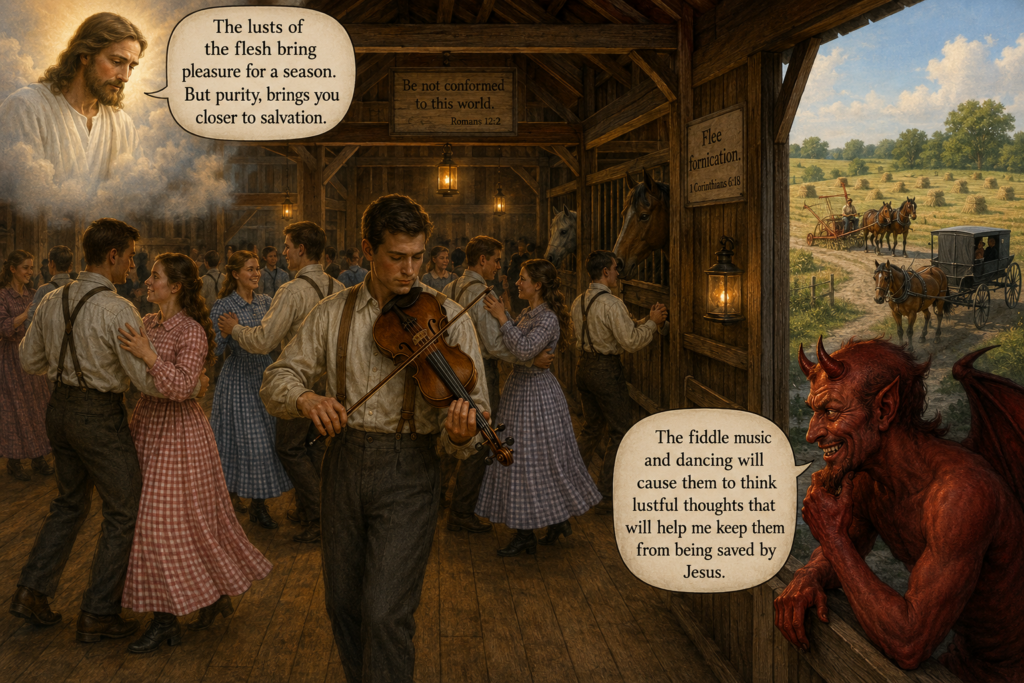
Years ago, disapproval of the fiddle ran deep, particularly in Evangelical Protestant Christianity common in the southern United States. “The Devil’s Box” could cause the faithful to stray. “The Devil’s Box” could result in a life of sin preventing salvation through acceptance of Jesus as Lord and Savior.
Jordi Guasch of Barcelona, Spain shares about “The Devil’s Box.” Guasch uses the work of great scholars such as Charles K. Wolfe, Bill C. Malone , Robert Cantwell, and Nick Tosches to outline ideas about “The Devil’s Box.
Guasch’s discussion also relates once again to the Sacred and Profane. Dr. Randal Williams and I focus on the Sacred and Profane in Country Music. It’s the tension between good and evil, right and wrong, being saved or being lost, between heaven and hell. If the fiddle is “The Devil’s Box” then it’s fighting against Jesus and salvation. Even today new Country Music artists reference Jesus in their music. It’s not going away.
Guasch always brings his unique input. Traveling in the Himalayas…“The Roof of The World”…in countries such as Bhutan results in the inclusion of Drukpa Kunley. Many Country Music lovers will wonder how Drukpa Kunley could be worked into a discussion of “The Devil’s Box.”
Jordi Guasch’s life in Spain plus his many travels means that he will bring a combination if sources to the discussion. Guasch will site established scholars. Guasch will also site the unexpected. Go ahead. Read Guasch’s article and you’ll find out the established and the unexpected.
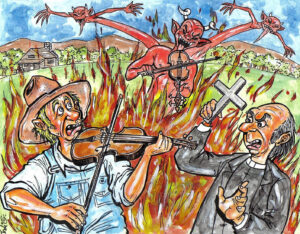
Several books have been published about the prominence of the fiddle in country music. I will focus on the negative religious perception held by many Evangelical Protestant Christians. Some African Americans, and others, thought the Blues was The Devil’s Music. The fiddle often had an equally negative reputation.
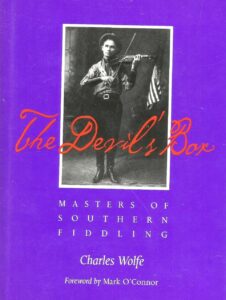
As prominent Country Music scholar Charles Wolfe said in The Devil´s Box:
they called the instrument with this name because some thought it was sinful to play. “Sometimes in recent years, people would be tearing down old log cabins to get at the logs and they would find hidden in the wall an old beat-up fiddle. At first they puzzled about this, but then people explained that the man who lived there was once a fine old-time fiddler, but that in later years he had gotten religion. In his zeal, he became convinced that he must turn his back on his old life, and especially that devil´s instrument, the fiddle.
Looking at the old tunes, wrote Wolfe:
you gave the fiddler a “dram”, and you heard tunes like Devils Dream and Devil in the Woodpile, Hell Among the Yearlings and Hell Broke Loose in Georgia, Hell and Scissors and Hell Bound for Alabama. And didn´t one take the rattles of a serpent – the rattlesnake – and put them in the fiddle to improve the tone? The evidence was strong, and many newly saved fiddlers took their instruments and smashed them against the wall. But others, unable to part with the heirlooms they had devoted so much of their lives to, quietly dropped them behind the walls of their cabins and kept quiet, hoping perhaps that some day in the future, in a kinder and more tolerant age, someone would find them and let them be heard again.
In the opinion of Country Music scholar Bill C. Malone, fiddlers evoked ambivalent images that reflected the shadows and origins of their European past. They carried the taint of the “sturdy beggar” of Elizabethan England, and the even older image of the “Devil as a fiddler”. Accounts of drunken or ne´er-do-well fiddlers appear frequently in eighteenth and nineteenth-century sources, including ads for runaway indentured servants.
Col. Alexander Walker, who had been a minor political figure in the early Arkansas territory, presented a relatively benign version of fiddlers when he said that God had created all things beautiful except whistling women, crowing hens, fiddlers, fire-dogs, and popcorn!
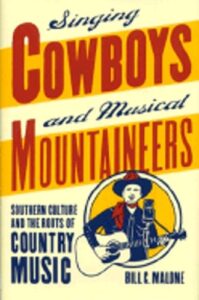
In Singing Cowboys and Musical Mountaineers, Malone says that Earl V. Spielman’s Traditional North American Fiddling… (University of Wisconsin, 1975), credits John Uties arrival in Virginia on the “Francis Bonaventure” in 1620 as the earliest example of early fiddlers arrival in the southern colonies. However, Nick Tosches refers to a man named John Laydon, or Lydon, who came from London to America in the spring of 1607 and brought a fiddle.
There, in Virginia, he made “some wondrous newe songs” and the first one was Devils Bitche! And the other is Drunk Negar. The first important reference to country music in America is the announcement of a fiddling contest in the November 26, 1736, issue of the Virginia Gazette. I don’t know how many “demons” were there inspiring the fiddlers. Perhaps the “demons” of alcoholic beverages!
In Europe, people genuinely believed that the 19th-century Italian virtuoso Niccolò Paganini played the violin like the devil. His technique was so astonishingly far beyond what anyone had ever heard that audiences and critics concluded his talents had to come from an otherworldly, sinister source.
Many religious people in the United States, both black and white, took a much dimmer view, depicting the fiddler as a wastrel, or as a person who lured other people toward sin. Even in the twentieth century A. P. Carter had to hide his love of the fiddle from his religious mother.
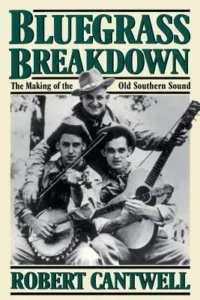 As Robert Cantwell states in Bluegrass Breakdown, in the Old Regular Baptist church and in other rural fundamentalist churches, “music”, meaning musical instruments, is prohibited entry into the meeting house, while “fiddling” is traditionally regarded by the pious as a form of idleness.
According to Bill C. Malone, the dissenting religious sects who populated the Southern Baptists, Methodists and German Pietist groups who came down the Great Valley of Virginia from Pennsylvania – brought traditions of music that wedded secular tunes to religious lyrics. Most would have easily agreed with the assertion, attributed to a musically tolerant English Anglican minister, Rowland Hill, that there was “no reason why the Devil should have all the good tunes!”.
In any case, the art of fiddling in the nineteenth-century South was not confined to the poor. Poor whites, drovers, flatboat men, yeomen, slaves, and free blacks did play fiddles, but so did planters, lawyers, judges, local political officials, governors, U.S. congressmen and senators, and even ministers of the gospel.
Antebellum newspapers, travel accounts, and other written sources make frequent references to slave fiddlers, but they are seldom described in a social context that includes white folk. We know, for example, about the “fiddling governor” Bob Taylor who was governor of Tennessee from 1887 to 1891 and again from 1897 to 1899. He was also a United States congressman and senator during his long public career.
In 1886 Bob campaigned for governor against his own brother Alf in the famous “War of the Roses”. Robert “Bob” Love Taylor won the 1886 Tennessee gubernatorial election against his brother, Alfred “Alf” A. Taylor. I don’t think he made a pact with the devil!
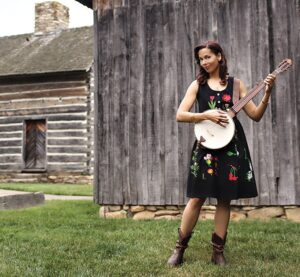
According to Tosches, the earliest references to slave fiddlers appeared in 1737, from the South Carolina Gazette. Musician and historian Rhiannon Giddens has frequently highlighted the foundational role of Black fiddlers in early American music, referencing the 17th century .
She frequently points to a mid-17th century legal dispute in Virginia. In it, households on the Eastern Shore fought over the services of an enslaved Black man because he could “play the fiddle all night for a party. This highlights that Black musicians were foundational to the origins of American roots music.
She points out that as early as the mid-17th century, enslaved Black people played the fiddle and the banjo, blending African rhythms with European melodies to create the earliest versions of string-band in country music.
In the book Tennessee Strings, Charles K. Wolfe mentioned a famous Tennessee fiddler of the 1790s, James Gamble. He read his Bible, prayed, and fiddled. A popular story tells of Gamble escaping an Indian attack, receiving several arrow wounds, and spending weeks in bed recovering. Gamble created a piece on his fiddle that depicted the attack, the Indian screaming, and his escape. It is unknown whether he received the devil’s help to survive the attack.
A little known sequence in the Roman Polanski 1968 film Rosemarys Baby merits attention. The image of a television appears in which a band is playing Devils Dream. Vivian Williams and Howard Marshall discussed Devil’s Dream on the CD Fiddle Tunes of the Lewis & Clark Era. The original for the tune Devis Dream is the Scottish reel The Devil Among the Tailors composed around 1790. It appears in Scottish Kerr collection as Devil’s Dream.
Many artist from young Suzuki students to the Broadway stage to barn dancers and contestants in old time fiddlers contest perform it. Devils Dream appears in my romantic, detective, mystery, and spiritual novel Black Lily / Pétalos de muerte (Caligrama editorial).
The devil may be a real entity or a product of our minds. The devil is a recurring and interesting element in Country Music from its beginnings in the 17th century and more specifically through fiddling tunes and murder ballads.

As I discovered during my trip to Bhutan, in the traditions of Tibetan Buddhism, Drukpa Kunley—the late 15th / early 16th-century “Divine Madman”—is renowned not for destroying demons, but for subduing them and transforming them into protectors of the Dharma.
Kunley used his fierce compassion and “Crazy Wisdom” to bring even the most feared spirits into the service of enlightenment. Considering the differences, we could interpret that, in Country Music, the devil is just an untalented fiddler, or that practice playing the fiddle helps unleash one’s inner demons
Consider that a good fiddler can show and teach another, as though metaphorically slaying the demon, which is nothing more than an imaginative projection of a lack of talent, adequate practice or technique playing this instrument. Kunley, who rejected rigid monastic rules to teach through unconventional and shocking methods, was famous for using humor, alcohol, and symbolic sexuality to strip away the ego and awaken direct insight.
If Kunley played a fiddle, its sound could be one of his resources to defeat each person’s inner demons, and transform those who haven’t mastered the technique of the instrument into good fiddlers!
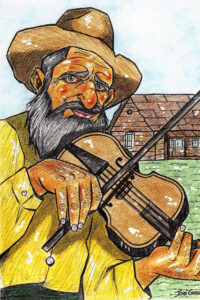
Regarding The Devil Went Down to Georgia, certain effects are used, common in other country songs about devils, ghosts and paranormal and supernatural themes, present on European Folk music. In The Vikings & The Celts, Fiona MacDonald and Philip Steele, indicate that most Celtic poetry was not spoken, but sung or chanted to the music of a harp or a lyre. Bards used the music to create the right atmosphere to accompany their words and to add extra dramatic effects such as shivery sounds during a scary ghost tale.
This has only been a brief summary of the relationship between country music fiddle / fiddlers, and the “Devil”. Other musical instruments may be considered to be diabolical. Demonic entities—whether a symbolic reality or not of the human collective unconscious duality—form part of musical art.
Are you a believer? Beware of The Devil’s Box! Not a believer? Rock-On and enjoy great fiddling! The choice is yours.